Last Updated: July 29, 2026
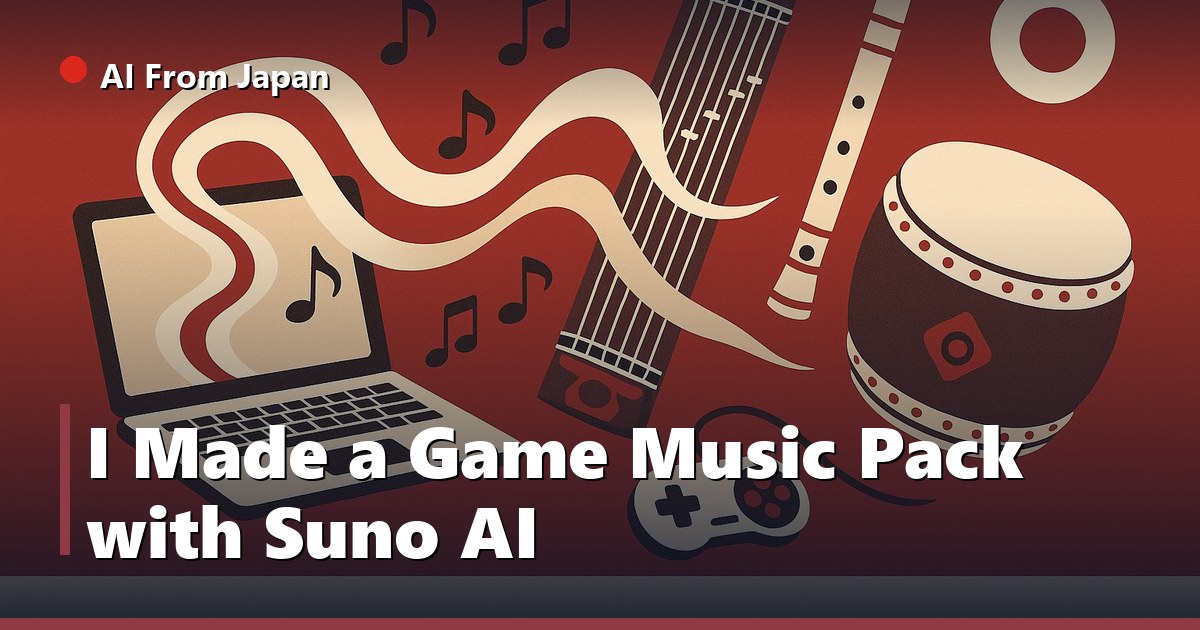
Two days. Twelve tracks. One asset pack, live on itch.io.
I want to be upfront about what this article is: not a “look how easy AI is” post. AI wrote the music. But the two days weren’t spent generating — generating took about ninety minutes. The rest was the part nobody talks about, which is also the only part that decides whether anyone buys.
Here’s the whole process, including the mistake that would have made every track legally unsellable if I’d caught it one day later.
⚡ Quick Summary
- What happened: 12 Japanese game BGM tracks generated with Suno AI, loop-engineered, and live on itch.io as a paid asset pack — in one weekend.
- The near-fatal mistake: Suno’s free tier gives you no commercial rights. Every sellable track must be generated while a paid plan is active.
- Real cost: Suno Pro at ¥1,750/month — but the AI is the easy 10%. Curation, loop editing and licensing are the actual product.
- What you get here: all six exact prompts, the rejection criteria, and the boring itch.io admin nobody warns you about.
- Not for you if you want passive income from raw AI output — that market is a race to the bottom, and I explain why I skipped it.
Disclosure: this post contains no affiliate links — the Suno links are plain links and I earn nothing if you subscribe. The WAFU music packs linked below are my own products, so I do earn directly if you buy one; that’s exactly why this article shows you the free sampler and the full process first. Read our full Affiliate Disclosure.
Hear the result first — free 3-track sampler →
(my own pack — free, same license as the paid volumes)
Why game music, and not Spotify
The obvious move with AI music is to flood streaming platforms. I didn’t, for one reason: that market is already drowning.
Thousands of people had the same idea, the payout per stream is fractions of a cent, and you’re competing on volume against people who will always out-volume you. It’s a race with no finish line.
Game developers are a different market entirely. An indie developer building an RPG needs a battle theme, a village theme, and something for the sad scene where the mentor dies. They need those tracks to loop cleanly, because a two-minute song that stutters every two minutes will drive players insane. And they need a license that clearly says “yes, you can ship this in a commercial game.”
That’s a product, with a real problem attached to it. Nobody is going to buy my music because it’s beautiful. They’re going to buy it because it saves them a week of searching.
The tool: Suno Pro (and the trap in the free tier)
I used Suno. I started on the free tier on day one, purely to test whether the Japanese instrumentation would come out convincingly.
It did. Shakuhachi, koto, shamisen, taiko — the timbres were genuinely close. Not indistinguishable from real players, but far past “good enough for a game soundtrack.”
So I upgraded to Pro (¥1,750/month, 2,500 credits). And here’s the thing I want to put in bold, because it nearly cost me the entire project:
Music you generate on Suno’s free tier does not come with commercial rights. You cannot sell it. You cannot ship it in a commercial game.
I had already generated a couple of test tracks I liked on the free plan. I had to throw them away and regenerate everything from scratch after subscribing. If you plan to sell what you make, every single track has to be generated while your paid subscription is active. Not before. Not “I’ll upgrade later and it’ll be fine.”
If you take one thing from this article, take that.
On credits: one generation costs 10 credits and returns two tracks. 2,500 credits a month means roughly 500 tracks — about 16 a day if you spread it out. Credits do not roll over, which changes the optimal strategy: don’t subscribe and then generate slowly. Subscribe and generate hard.
The six prompts that actually worked
I built the pack around the six scenes every RPG needs. Here are the exact prompts, pasted into the Style field with Instrumental ON and the lyrics box left empty:
Title screen
Traditional Japanese instrumental, koto and shakuhachi, calm and mysterious,
slow tempo, atmospheric, minimal percussion, meditative, game title screen
music, no piano, no electric guitar
Village / hub
Peaceful Japanese folk instrumental, koto, shamisen, bamboo flute, warm and
nostalgic, medium-slow tempo, gentle taiko, cozy village atmosphere,
relaxing loop, no piano
Normal battle
Intense Japanese battle music, fast taiko drums, aggressive shamisen riffs,
epic orchestral strings, driving rhythm, high energy, samurai combat theme,
instrumental
Boss battle
Dark epic Japanese boss battle theme, thunderous taiko ensemble, dissonant
shakuhachi, heavy orchestral brass, ominous atmosphere, fast and menacing,
instrumental
Sad scene
Melancholic Japanese instrumental, solo shakuhachi with soft koto, sorrowful
and emotional, very slow, sparse arrangement, rain atmosphere, cinematic
sadness, no vocals
Shrine ambient
Ethereal Japanese ambient, distant temple bells, wind chimes, drone texture,
gagaku instruments, mystical shrine atmosphere, slow and spacious, no drums,
no vocals
Two things I learned writing these:
Negative prompts do the heavy lifting. Left alone, Suno drifts toward Western instrumentation — piano and electric guitar creep in and instantly kill the atmosphere. no piano, no electric guitar is the single highest-value phrase in these prompts.
Never name a real artist, song, or game. Not “Zelda-style,” not a composer’s name. Beyond the obvious legal problem, it produces worse output — you get a vague imitation instead of a clear instruction. Describe the instruments and the emotion instead. That’s what the model actually understands.
Curation: the part that makes it a product
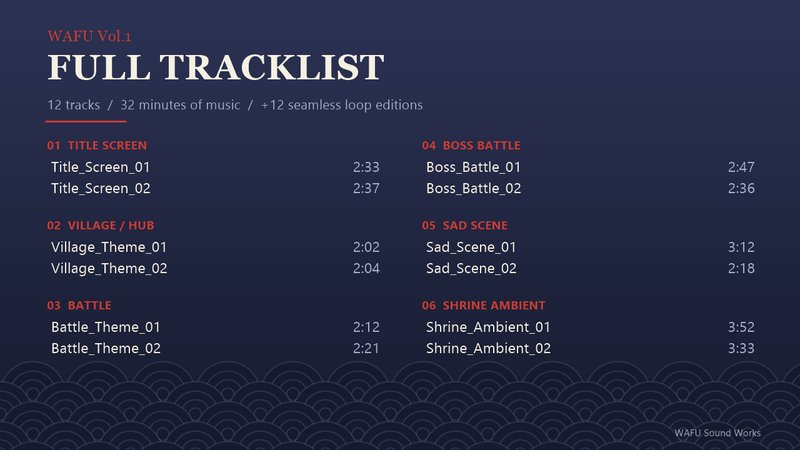
Each prompt returns two tracks. I ran each prompt once, listened to both, and kept the better one. Twelve tracks, six scenes, two takes each.
My criteria, in order:
- Instrument authenticity — does the shakuhachi actually sound like a shakuhachi, or like a generic flute patch?
- Natural development — does it go somewhere, or does it just sit there for two minutes?
- Density — does it sound thin and hollow on good speakers?
- Loop tolerance — this one matters most, and I’ll come back to it.
I rejected roughly half of what I generated. That rejection rate is the product. Anyone can generate 500 tracks a month; the pack is worth money precisely because someone listened to all of them and threw most away.
The part AI can’t do: loop engineering
This is where the actual work was, and it’s the reason the pack can charge more than zero.
Suno gives you a song. A song has an intro, a build, and an ending. That structure is exactly wrong for a game, where the track has to repeat forever without the player noticing the seam.
For every track I:
- Trimmed the silence at the head and tail. Suno often leaves a fraction of a second of dead air, and in a loop that’s an audible hiccup every two minutes.
- Crossfaded the tail into the head — I overlapped the last 5–8 seconds with the beginning of the track so the loop point becomes a smooth transition instead of a hard cut.
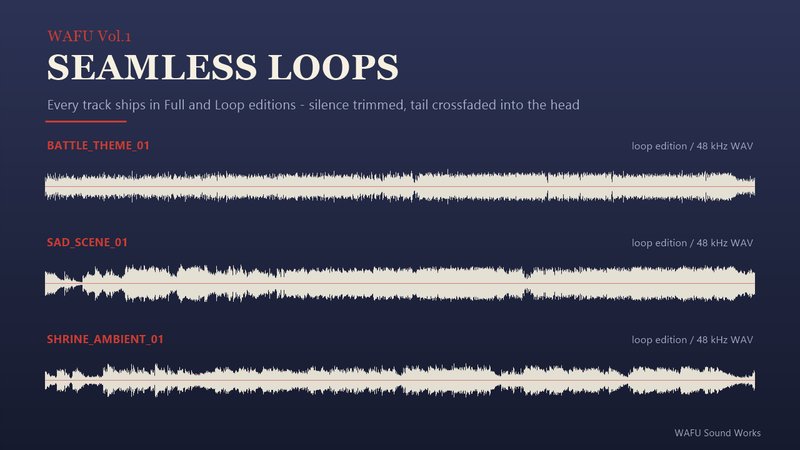
The result is that every track ships in two versions: Full (with the natural ending, for cutscenes and menus) and Loop (seamless, for gameplay). Twelve tracks became twenty-four files, and then forty-eight once I exported both WAV (48kHz/16-bit) and OGG.
OGG matters more than it sounds. Unity, Godot, and RPG Maker developers generally want compressed audio in the build — shipping only 700MB of WAV means the buyer has to convert everything themselves. Including both formats is a fifteen-minute export that removes an hour of the buyer’s work.
Nothing about this step is glamorous, and none of it is AI. It’s just the difference between “some AI songs” and “a game asset pack.”
See WAFU Vol.1 — the pack this article built →
(my own product — 12 tracks, Full + Loop editions, WAV & OGG)
Licensing: say the quiet part out loud
I wrote a plain-language license and put it in the pack:
Buyers can use the music in unlimited commercial and non-commercial projects, modify and remix it, use it in monetized content, and keep using it forever with no royalties or recurring fees. No credit required.
Buyers cannot resell or redistribute the audio files themselves as standalone audio, upload the tracks to streaming platforms as their own work, or use the files to train generative AI models.
I also disclosed the AI use directly on the store page and in the license file. This was a deliberate choice, and I’d argue it’s the correct one commercially, not just ethically. Developers are going to find out anyway. Being upfront turns a potential “you hid this from me” refund into a non-issue, and it lets me be honest about the thing that actually differentiates the pack: not that a machine generated it, but that a human curated, edited, and loop-engineered it.
Publishing on itch.io: the boring administrative reality
A few practical things that cost me time:
Turn your browser’s auto-translate OFF. I’m serious. With Chrome’s translation running on itch.io’s editor, form submissions broke in ways that were extremely confusing to debug. Ten minutes gone before I figured out the cause.
Tax setup comes before your first sale, not after. As a non-US seller I filled out a W-8BEN. Under the Japan–US tax treaty this brings withholding on sales to US buyers down to 0%. Skipping this means money silently disappearing from every sale.
Screenshots aren’t optional for asset packs. Music is invisible. A store page for an audio product with no visuals is just a wall of text asking for $8. I made four images — the full tracklist, waveforms of the loop versions, a breakdown of what’s inside, and the six scenes — and a three-minute preview video with fifteen seconds of every track. That preview video is the single most important asset on the page, because it’s the only thing that lets a buyer answer “does this sound good?” before paying.
You don’t need PayPal on day one. itch.io can collect payments on your behalf and pay out later, so you can launch and sort the payout details out when there’s actually money to move.
Honest assessment
What worked
- 🎵 The instrumentation is genuinely convincing. This was not true of AI music two years ago.
- ⚡ Two days from “let’s try this” to a live, purchasable product.
- 🎯 Picking a niche (Japanese-style, scene-organized) rather than competing on volume.
What didn’t
- The free-tier commercial rights mistake cost me a full regeneration cycle.
- 742MB of WAV files is unwieldy to upload and download. I’d consider splitting future packs.
- AI music has an active legal cloud over it — Suno is in ongoing litigation with major labels as of mid-2026. I’m treating my tooling as replaceable rather than assuming today’s rules hold forever.
Would I do it again? Yes, and I already have — three days after Vol.1, Vol.2 (Japanese horror) went live; Vol.3 (visual novel / slice of life) followed within the week, and the raw material for seven more volumes is generated and sitting in folders. But I’d tell anyone starting this that the AI part is the easy 10%. The curation, the loop engineering, the licensing, the store page, the preview video — that’s the actual job, and it’s the only reason the thing has any value.
Frequently asked questions
Can you sell music made with Suno commercially? Yes — but only tracks generated while a paid subscription (Pro or Premier) is active. Free-tier generations do not come with commercial rights, and upgrading later does not retroactively license them. This is the mistake that almost sank this project; see above.
Which Suno plan do you need for an asset pack like this? Pro (¥1,750/month) was enough for everything in this article. 2,500 credits a month is roughly 500 tracks — one volume of 12 final tracks, including rejected takes and re-rolls, used well under a tenth of that. Premier only makes sense if you are generating at industrial volume.
Do buyers care that the music is AI-generated? Some do — on itch.io, “No AI” is actively used as a selling point by other sellers, and the platform requires AI disclosure. My approach is to disclose it plainly and compete on the parts AI doesn’t do: scene curation, real loop engineering, four formats per track, and a human ear rejecting the bad takes. Hiding it is both against the rules and, frankly, a worse strategy than owning it.
Is the legal situation around Suno settled? No. Suno is in ongoing litigation with major labels as of mid-2026. I treat my tooling as replaceable — the packs, the brand, and the workflow would survive a switch to a different generator.
Try it yourself
If you want to generate music like this, you’ll need a paid Suno plan for anything you intend to sell: Suno (no affiliate link — I don’t earn anything if you subscribe)
And if you’d rather skip the two days and just get the music, that’s what the pack is for:
🎴 WAFU Vol.1 — Japanese Game Music Pack — 12 tracks across 6 RPG scenes, Full + seamless Loop editions, WAV and OGG, royalty-free, no credit required.
👹 Japanese Horror Music Pack — WAFU Vol.2 — the same treatment, somewhere darker. 12 horror tracks plus 4 stingers.
🌸 Visual Novel Music Pack — Japanese Slice of Life (WAFU Vol.3) — daily life, comedy, confession, memory, tension, hope.
🆓 Not sure? The WAFU Free Sampler is three complete tracks — one from each volume — free, same license. Hear how the loops behave in your engine before spending anything.
🎧 Listen to the full preview — every track, fifteen seconds each.
About the author
I’m Ryuyan Kimura, a content blogger based in the Kansai region of Japan — and a native Japanese speaker. I review AI tools, VPNs, and learning resources for English-speaking expats and Japanese learners. Everything in this article is my own hands-on experience: I generated, edited, and published the music packs described here myself.
Want the full story? Read my About page or check our Editorial Standards for how we test products.
Related Articles You Might Find Useful
More hands-on AI tooling from Japan: