Short answer: yes. There is Japanese horror music you can put in a commercial game for free, with no credit and no royalties, and a good part of what I’m about to point you to is music I made and give away. That is a conflict of interest, so I’ll say it up front: I run WAFU Sound Works, I live in Japan, and the music is produced with generative AI (Suno, commercial plan) and then cut, looped and level-matched by hand. There are no affiliate links in this post.
What I can offer that a “Best 10 free horror music packs” list can’t is the other half: where each free pack falls short, which of my own tracks are too short to do their job, and the one kind of project where you should not use any of this, free or paid.
What “Japanese horror” should actually sound like
A lot of music sold as “Japanese” is not. The most common giveaway is the erhu and the guzheng, which are Chinese instruments. Players who know the difference notice, and they say so in the comments. The instruments you want are the koto (a long plucked zither), shakuhachi (bamboo flute, breathy and close), shamisen, taiko, and for anything near a shrine or temple, a bonshō (the big bronze temple bell) or small shrine bells.
The places matter as much as the instruments. Western horror lives in basements and woods. Japanese horror, the kind people now search for after games like The Exit 8, lives in places that are completely ordinary in daytime: a convenience store at 3am, a station platform after the last train, a danchi (public housing block) walkway, a school after hours. I walk past all of these every week. They are quiet, lit, and slightly wrong, and the music for them should be too: thin, low, more hum than melody.
The free options, and what each one is good for
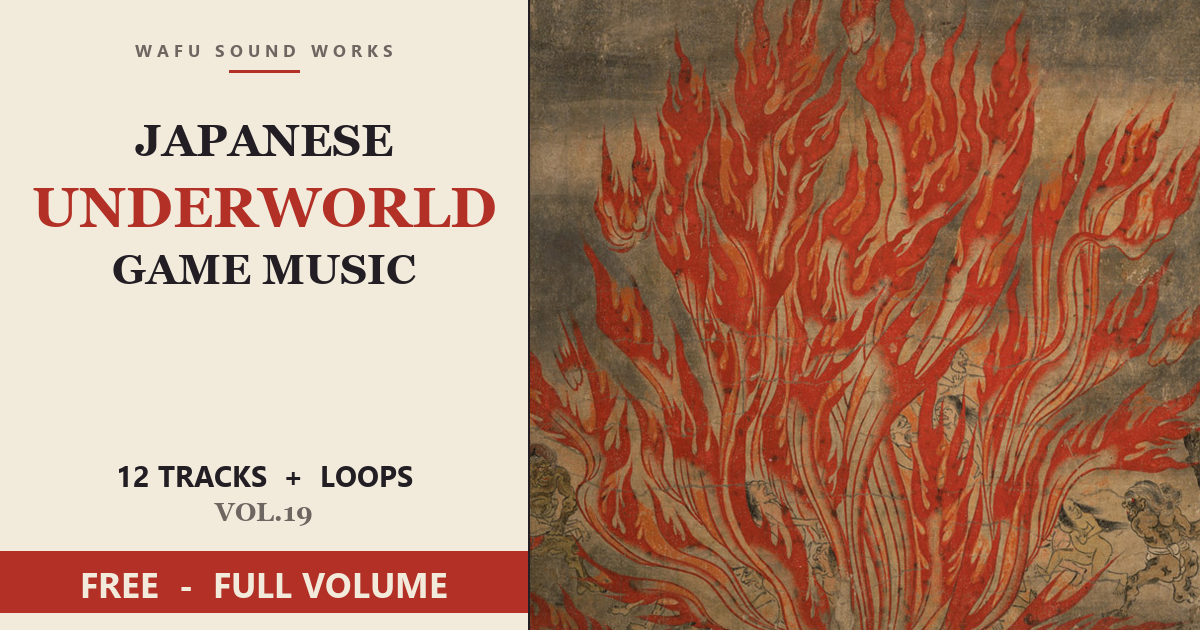
1. The Road Down: a Japanese underworld (WAFU Vol.19, free)
The Road Down is a complete volume, not a sample: 12 tracks and 8 cues, 32 minutes, every track over two minutes, each as a full take and a seamless loop in WAV and OGG. It scores the Japanese land of the dead: the Sanzu river crossing, the gate, Enma’s judgement hall, an empty plain of ash, whatever rules the place, and a road back that keeps arriving where it began.
Good for: roguelike descents, dark fantasy, souls-likes, dungeon crawlers. One playlist per area.
Not good for: jump scares. This is scale and myth (koto, shakuhachi, hichiriki, shō, taiko and temple bells over very low drones). It will not make anyone flinch.
2. Liminal Japan at 3am (WAFU Vol.28, free)
This one is the closest to what most people mean by “Japanese horror” in 2026: a konbini at 3am, the last platform, a hotel corridor, a stairwell, an underground car park, and dawn as the way out. 12 tracks, 8 cues (a shop door chime, a platform departure tune, an elevator ding, a fluorescent tube stuttering on), 33 minutes, same license as the paid packs.
Good for: walking simulators, liminal and backrooms games, anomaly games, the quiet first act of a horror visual novel.
Not good for: chases. Nothing here builds or runs. That is deliberate, and it means you will need something else once the monster shows up.
3. The Spooktober Mini Pack (free, 3 tracks + 2 stingers)
Three full tracks and two stingers: an ordinary room where one thing is off, a corridor you should not walk down, and something searching from room to room. Plus a jump scare hit and an analog static burst. It was made for jam season, so there is a small OGG-only download if you just want to try them in your engine.
Good for: a short horror VN or a jam game that needs an opening, one tense walk, and one scare.
Not good for: anything longer than an hour. Three tracks wear thin fast.
4. Single tracks from the two Free Samplers
If you want to hear the paid horror volumes before paying, the first Free Sampler includes Cursed Shrine from the folk-horror volume, and the second one includes a station underpass track from the anomaly volume and a Showa-era lounge tune from the co-op horror volume. They are whole tracks with the same loop edits and license, not clips.
Where it fails (including my own stuff)
I promised the weak spots, so here they are.
- My oldest horror chase tracks are too short. In the folk-horror volume (Vol.2), the two chase tracks run 1:22 and 1:19. In a long pursuit the loop becomes obvious within a few minutes. AI music tools are worst at exactly this kind of track: ask for “fast” and “chase” and you tend to get a sprint that ends. I only found a way around it much later, and the survival horror volume (Vol.14), where the chase tracks run 2:29 and 2:43, is the result. If your game has long chases, don’t rely on the old ones.
- Free packs are thin on the “game” part of horror. Atmosphere is easy to give away. Hiding, being found, being chased, getting away: those states need tracks that crossfade into each other, and that is where I put the work into paid volumes.
- Loop fatigue is real. Players start noticing a loop after three to five repeats. Two takes per scene helps; so does letting a track play twice and then dropping into 20 to 40 seconds of silence. The Vol.19 README includes code for that in Godot 4 and Unity.
- It is AI-assisted, and some people will not want that. I disclose it on every page and in every LICENSE file. If “made by a human composer” is part of your game’s identity, this is not your music.
The one case where you should not use any of this
Game jams that ban generative AI. This is not a theoretical warning. In September 2026 I read the rules of 124 running and upcoming jams with 60+ entrants. Roughly 70 banned generative AI outright, 34 said nothing, and only 6 allowed it with disclosure. Several of the biggest, including Spooktober VN Jam, extend the ban to third-party assets. That means a free AI-assisted pack can disqualify your entry even though you didn’t generate anything yourself.
So before you download anything, read your jam’s rules for the word “AI”. If it says nothing, ask the host. If it allows AI with disclosure, my LICENSE.txt states how the music was made, so you have it in writing.
How to check any free horror music before you use it
Whoever you get it from, check these six things. Most problems I see in comments come from skipping one of them.
- Commercial use: “free” sometimes means free for non-commercial projects only.
- Credit: is attribution required, and in what form?
- Content ID: will your trailer or a streamer’s video get claimed? (Mine are not registered with Content ID or any fingerprinting service, so you won’t get claims from me.)
- Loops: is there a real loop edit, or will you hear a gap every time it wraps?
- Length: anything under two minutes will be heard as a loop in a scene longer than a few minutes.
- Restrictions: most licenses forbid reselling the audio as-is or uploading it to streaming services. Some also forbid AI training. Know what you agreed to.
My honest conclusion
- If you’re making a short horror VN, a jam game (in a jam that allows AI), or a walking/liminal game: the free packs are enough. Start with Vol.28.
- If you’re making a dark fantasy descent or a roguelike: Vol.19 covers the whole run for free.
- If your horror has stealth, chases or co-op: free will run out quickly. That is what the paid volumes are for: Vol.14 for hiding and being hunted, Vol.11 for present-day schools and apartment blocks, Vol.2 for shrines and abandoned villages (mind the short chase tracks), Vol.58 for anomaly games, and Vol.61 for co-op night shifts. They are $7.99 each, or five horror volumes for $29.99 in the Dark Quintet.
- If your jam bans AI, or you want a human composer’s name on the credits: don’t use any of this. Search itch.io’s free music assets and read each license carefully.
FAQ
Can I use these free tracks in a game I sell on Steam?
Yes. The free volumes use the same royalty-free license as the paid ones: unlimited commercial and non-commercial projects, no credit required, no royalties.
Do I have to credit WAFU Sound Works?
No. You’re welcome to, but it isn’t required.
Can streamers play my game without getting copyright claims?
From me, yes. None of these tracks are registered with YouTube Content ID or any other fingerprinting service.
What formats do I get?
WAV (48kHz/16-bit) and OGG, each track as a full take and a seamless loop. They drop into Unity, Godot, Ren’Py and RPG Maker without conversion.
Is this music made by AI?
It’s AI-assisted. The tracks are generated with Suno on a commercial plan, then a person auditions and rejects takes, designs the scenes, trims and loops every track, and matches the levels. I wrote about that process in detail here.
Why give complete volumes away?
Because a three-track “sample” doesn’t tell you whether a pack will hold up through a whole game. A complete volume does. If it works for you, you’ll know where to find the rest. If it doesn’t, you’ve lost nothing.