Short answer: partly. You can score a surprising amount of a Japanese-style RPG for free (the overworld, a temple, an underworld descent, a winter region) with music you can ship in a commercial game, no credit, no royalties. What you will not find free from me is the town theme, the normal battle and the boss. I’ll explain why, and where the gaps are.
The conflict of interest first: I run WAFU Sound Works, I live in Japan, and every pack I’m about to point you to is mine. The music is generated with AI (Suno, commercial plan), then I audition and reject takes, design the scenes, cut the loops and match the levels by hand. There are no affiliate links in this post.
What a Japanese RPG soundtrack actually needs
A JRPG soundtrack is usually planned as places: title screen, village, field, dungeon, battle, boss, a sad scene, a shrine. Most free packs give you moods instead (“epic”, “calm”, “mysterious”) and leave you to work out which one is the field theme.
The instruments matter too. If it is supposed to sound Japanese, you want the koto, shakuhachi, shamisen and taiko, and near a temple the mokugyo (wooden fish) and the big bronze bell. The erhu and guzheng are Chinese; players who know the difference will tell you in the comments.
And there is one track most soundtracks under-serve. Everybody scores the town. Nobody scores the road. Yet the overworld theme is the cue the player hears the longest, by a wide margin, and it decides whether a forty-hour game is pleasant to be inside.
The free options, and what each one covers
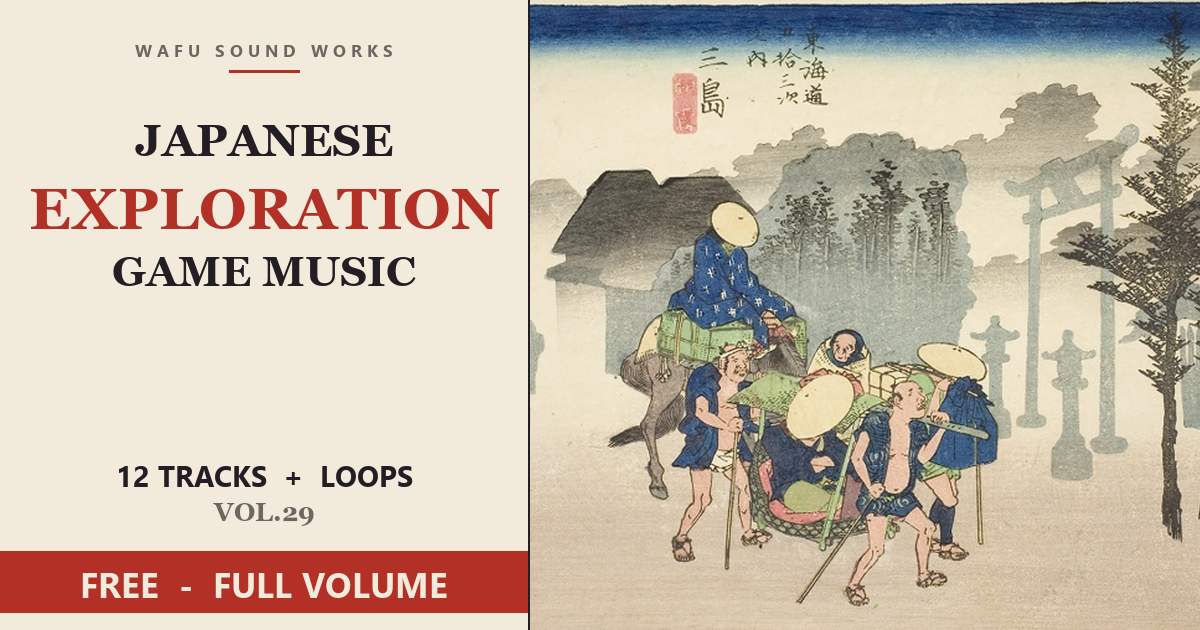
1. The Long Road: the overworld (WAFU Vol.29, free)
The Long Road is a complete volume, not a sample: 12 tracks and 8 cues, 35 minutes 44 seconds, every track over two minutes, each as a full take and a seamless loop in WAV and OGG. It is only the space between places: The Grass Road (the default world-map theme, 3:29 and 3:19), The Mountain Pass, The Forest Road, Night Camp, Rain on the Road and The Summit.
The road, the pass and the forest share a tempo feel and instruments, so crossfading at a zone border sounds like the same journey continuing. Night Camp has no drums at all, which is what makes it read as stopping. The cues are Discovery, Quest Complete, Waypoint and Rest, two variants each, because a waypoint chime fires hundreds of times in one playthrough.
Good for: the world map, travel between towns, camp and party-menu screens.
Not good for: anything urgent. Nothing in it arrives or builds, on purpose.
2. The Mountain Temple: a Buddhist temple area (WAFU Vol.35, free)
The Mountain Temple is one temple walked through in order: the stairs, the great hall, the morning service, the bell tower, the training hall, the mist outside. It is built from real Buddhist temple instruments (wooden fish, the standing bowl, the shō mouth organ, a bronze bell) rather than the usual flute over a pad. 12 tracks, 8 cues, 30 minutes 33 seconds.
Temple areas are where players stand still longest, and a slow loop gives itself away when the same bell lands on the same second every time. The README includes Godot 4 and Unity code that plays one scene as a quiet bed and scatters the bell, bowl and incense cues over it at random times and volumes.
Good for: temple towns, save points, training screens, a hub you return to.
Not good for: a Shinto shrine. A shrine and a temple sound different, and this is the temple.
3. The Road Down: the underworld (WAFU Vol.19, free)
The Road Down scores the Japanese land of the dead: the Sanzu river, the gate, Enma’s judgement hall, the Plain of Ash, whatever rules the place, and No Way Out for death and retry. 12 tracks, 8 cues, 32 minutes 9 seconds, every track over two minutes. The README has Godot 4 and Unity code that plays an area’s track a couple of times, rests for 20 to 40 seconds of silence, then fades back in, so a long dungeon floor doesn’t turn into the same loop for an hour.
Good for: a late-game descent, a dark dungeon chapter, a roguelite RPG.
Not good for: a cheerful adventure. It is low drones and temple bells.
4. The Long Winter: a snow region (WAFU Vol.32, free)
The Long Winter is one Japanese winter written as six states: first snow, the snowed-in village, the frozen pass, the blizzard, snow at night, the thaw. No sleigh bells. Its README code takes a single snow-intensity number and moves between light snow, heavy snow and the blizzard by volume only, so the music never jumps back to its first bar when the weather changes.
5. Shrine Ambient, from the Free Sampler
The Free Sampler includes Shrine Ambient (3:52) from the paid RPG volume, the full track with its loop. If you want to hear the paid RPG pack before paying, this is the honest way to do it.
Where it falls short (including my own stuff)
- No town, no battle, no boss for free. The free volumes cover places you pass through. The only village track among them is snowed in. A normal village theme, a battle theme and a boss theme are in the paid packs, and I’ll be straight about that rather than pretend the free set is a whole game.
- Some tracks are under two minutes. Vol.35’s Morning Service I is 1:32, and Vol.32 has two short ones (Snow on the Village II at 1:32, Blizzard I at 1:58). Each scene has a longer second take, and the descriptions name which one to use. In a scene longer than a few minutes, a 1:32 loop will be heard as a loop.
- The instruments are Japanese. Koto, shamisen, shakuhachi and taiko will not suit a European-castle fantasy. If your RPG has knights and taverns, this is the wrong music.
- Audio files only. Full and loop versions in WAV (48kHz/16-bit) and OGG, plus cues. No stems, no MIDI, so you can’t strip out one instrument.
- It is AI-generated. I disclose it on every page and in every LICENSE file. If a human composer is part of your game’s identity, this isn’t your music.
One thing only I can tell you about how these were made: AI music tools are bad at length. When I generated The Summit for Vol.29, the first take came back at 1:32. I extended it to 2:59 and compared the takes by ear before replacing it. Separately, Night Camp came out quieter than the rest, so I raised it 1.2 dB to about -14.6 LUFS. That checking, track by track, is the part I don’t let the tool do.
When you should not use any of this
Game jams that ban generative AI. In September 2026 I read the rules of 124 running and upcoming jams with 60+ entrants. Roughly 70 banned generative AI outright, 34 said nothing, and only 6 allowed it with disclosure. Several extend the ban to third-party assets, so a free pack can disqualify an entry even though you generated nothing yourself. Some RPG Maker jams I read did allow AI with disclosure, so it depends entirely on the jam: search the rules for “AI”, and if they say nothing, ask the host.
The same goes for any store, publisher or contest with an AI policy. Read it before you build your soundtrack around anything.
How to check any free RPG music before you use it
- Commercial use: “free” sometimes means non-commercial only.
- Credit: is attribution required, and in what form?
- Content ID: will a streamer’s video of your game get claimed? (Mine are not registered with Content ID or any fingerprinting service.)
- Loops: is there a real loop edit, or a gap every time it wraps? World-map music wraps hundreds of times.
- Length: anything under two minutes will be heard as a loop in a long field or dungeon.
- Format: RPG Maker wants OGG in
audio/bgm/for music andaudio/se/for cues. My READMEs say exactly that; check that whatever you download comes in OGG.
My honest conclusion
- If you need the field, a temple area, a dark descent or a winter region: the free volumes cover them completely. Start with Vol.29; the world map is the track your players will hear most.
- If you need a whole JRPG from title screen to final boss: free will run out at the town and the first fight. That is what the paid volumes are for (below).
- If your setting is European fantasy, or your jam bans AI, or you want a human composer credited: don’t use any of this. Search itch.io’s free music assets and read each license.
If you need the rest of the game
The paid RPG volumes are $7.99 each:
- Vol.1, Title to Final Boss: title, village, battle, boss, sorrow, shrine. The village tracks are 2:02 and 2:04, so they are on the short side for a hub you stay in.
- Vol.13, Beneath the Shrine: one dungeon descent with a real safe room, an ambush theme, a guardian and the walk back up, plus treasure, trap, secret and level-up cues.
- Vol.30, The Last Enemy: the sealed door, first form, second form, the true enemy, a tragic guardian and after the battle. Its README keeps the music running across a retry instead of restarting on every death.
- Vol.4, Banners in the Wind (samurai war), Vol.10, Matsuri Nights (a festival town at night) and Vol.7, The Spirit Road (yokai fantasy).
Vol.1, Vol.4 and Vol.10 together are $19.99 in the Epic Trilogy. For what it’s worth, it is the only one of my bundles that has sold more than once. Here is Vol.1 used in a three-minute mock RPG, so you can hear it under gameplay rather than in a playlist:
FAQ
Can I use the free volumes in a game I sell on Steam?
Yes. They use the same royalty-free license as the paid ones: unlimited commercial and non-commercial projects, no credit, no royalties.
Do they work in RPG Maker?
Yes. Put the loop OGG files in audio/bgm/ and the cues in audio/se/. The loops are already edited, so you don’t set loop points yourself.
Do I have to credit WAFU Sound Works?
No. You’re welcome to, but it isn’t required.
Will streamers get copyright claims?
Not from me. None of these tracks are registered with YouTube Content ID or any other fingerprinting service.
Is this music made by AI?
Yes, generated with Suno on a commercial plan, then auditioned, trimmed, looped and level-matched by a person. I wrote about that process here.
Why give complete volumes away?
Because a three-track sample can’t tell you whether a pack will survive forty hours of world map. A complete volume can. If it holds up, you’ll know where the rest is.


Comments