Short answer: yes. There is Japanese-style music you can put in a commercial visual novel for free, with no credit and no royalties, and most of what I’m about to point you to is music I made and give away. That is a conflict of interest, so here it is up front: I run WAFU Sound Works, I live in Japan, and the music is produced with generative AI (Suno, commercial plan) and then auditioned, cut, looped and level-matched by hand. There are no affiliate links in this post.
A visual novel is the hardest place to hide a weak music track. The player is not running or fighting; they are reading, sometimes for twenty minutes on one background. Every gap in the loop, every track that is too short, every crescendo that lands on top of a line of dialogue gets heard. So instead of a list, this is what each free pack is good for in a VN, where it falls short, and the one kind of project where you shouldn’t use any of it.
What a visual novel actually needs from its music
Three things, in my experience of cutting these files:
- Length. A track under two minutes will be heard as a loop long before the scene ends. Two takes per scene helps even more: you can alternate them across days or chapters.
- A real loop edit. Not a file that stops and restarts with a gap, but one where the tail is folded back into the opening, so the engine can loop the whole file and nobody hears the seam.
- Nothing that fights the text. Big builds and climaxes pull the eye off the dialogue box. Good VN music is closer to a room than a song.
The “Japanese” part matters too. If your story is set in Japan, the places carry as much as the instruments: a kissaten (an old coffee shop) where the cups keep being set down, the last train home, rain on a tiled roof heard from inside, a small apartment with an electric fan turning all afternoon. I live with all of these. They are what most slice-of-life VNs set in Japan are actually about, and they are what the free packs below are built around.
The free options, and what each one is good for in a VN
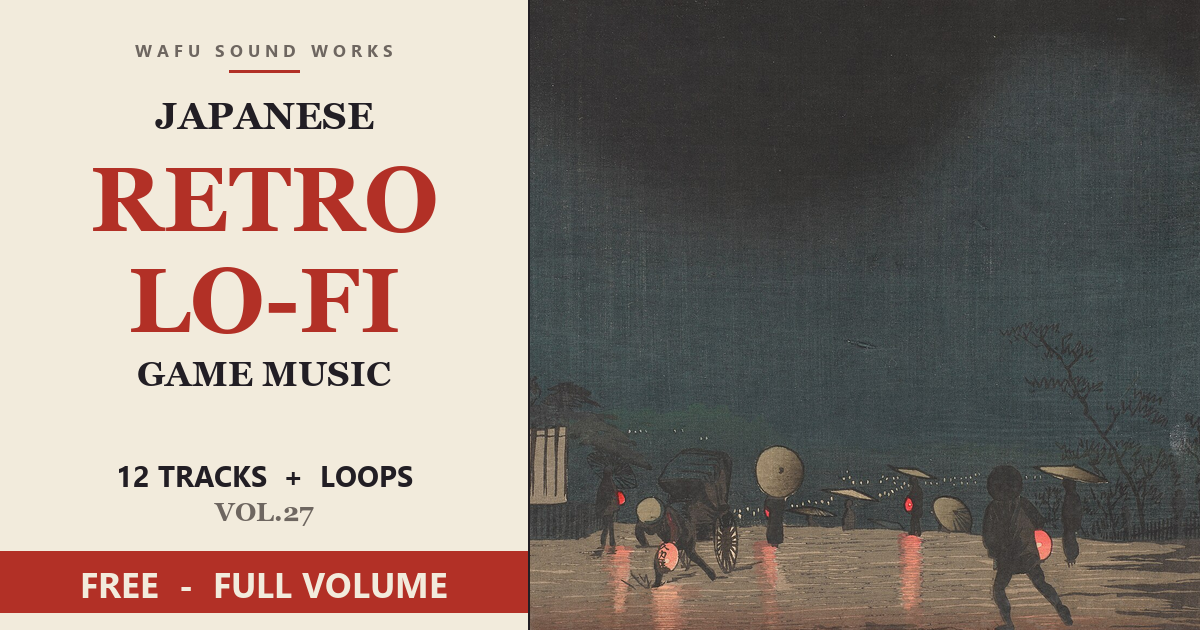
1. Coffee and Rain: Showa-era retro lo-fi (WAFU Vol.27, free)
Coffee and Rain is a complete volume, not a sample: 12 tracks and 8 cues, 29 minutes 54 seconds, each track as a full take and a seamless loop in WAV and OGG. It is six places in one old Japanese city running from evening to morning: the coffee shop, the last train, a street where rain falls on lit signs, a summer room, a record player at home, and the morning after. Electric piano and brushed drums with koto, shamisen and bamboo flute on top. The cues are small and domestic: a cup set down, a door chime, a needle drop, a station bell.
Good for: slice-of-life and romance VNs set in Japan, a cafe or apartment as the hub, “the morning after” as an ending or credits track.
Not good for: anything tense. Nothing in it builds.
2. The Long Rain: six kinds of rain (WAFU Vol.31, free)
The Long Rain is 12 tracks and 8 cues, 34 minutes 51 seconds, every track over two minutes: rain on the roof, rain in the bamboo, rain on the road, distant thunder, night rain past a paper window, and the quiet after it stops. Koto, shakuhachi, bamboo flute, taiko and soft strings, with the rain texture already inside the music.
Good for: the rainy-day chapter every VN seems to have, a confession under an umbrella, “distant thunder” as tension without a villain.
Not good for: games that already play a loud rain ambience. Two rains at full volume just sound like a louder storm; keep one of them low.
3. Liminal Japan at 3am (WAFU Vol.28, free)
If your VN is a horror or mystery story, this one covers the quiet first act: a konbini at 3am, the last platform, a hotel corridor, a stairwell, an underground car park, and dawn as the way out. 12 tracks, 33 minutes 22 seconds, every track over two minutes. Calm and wrong rather than scary. Nothing jumps or chases, so you’ll need something else once the story turns.
4. The Long Winter (WAFU Vol.32, free)
A Japanese winter, not a Christmas one: first snow, a snowed-in village, a frozen pass, a blizzard, snow at night, the thaw. No sleigh bells, no carols. Useful for a winter chapter or a final act in the snow.
5. Single VN tracks from the two Free Samplers
The first Free Sampler includes Bittersweet (2:38), a confession and tender-scene track from the paid slice-of-life volume. The second Free Sampler has two more that belong in a VN: Writing Desk II (3:43), piano with Japanese instruments for narration, letters and menus, and Broken Classroom I (3:31), the after-school classroom once a yandere route has gone wrong. They are whole tracks with the same loop edits and license as the paid packs.
Using them in Ren’Py
Use the files in the Loop folders. Ren’Py’s music channel loops by default, and these loops were cut to be looped as whole files, so there are no loop points to set. One line is worth knowing, because a common complaint in long VNs is the track restarting from bar one every time a new label asks for the same music:
play music "audio/wafu/your_track_loop.ogg" fadein 2.0 if_changedif_changed tells Ren’Py to leave a track alone if it is already playing. And one honest note that most packs skip: because the tail of each loop is folded into its head, the very first second carries a trace of the ending. A fade-in of a second or two hides it completely.
Where it falls short (including my own stuff)
- Some tracks are too short for a long read. In Vol.27, Neon and Rain II runs 1:45; use Neon and Rain I (3:31) for long scenes. In Vol.32, Snow on the Village II is 1:32 and Blizzard I is 1:58. My oldest paid VN volume has the same problem: in Vol.3, two tracks run 1:44 and 1:36. I list these on the pages because you will find them anyway.
- These are places, not characters. The free packs score where the scene happens. There are no character themes, and no track for “the heroine walks in.”
- The instruments are Japanese. Koto, shamisen, shakuhachi. If your VN is set in a Western fantasy kingdom or a sci-fi station, this will sound like the wrong country.
- No stems, no MIDI. You get finished stereo tracks. If you want to strip out the drums or re-voice the melody, this isn’t the right source.
- Most packs are mixed at game level, not reading level. I mixed the piano VN volume (Vol.49) about 1 LU quieter on purpose, at -15.0 LUFS, so it sits under text. The free packs are a little louder, so turn your music channel down a notch rather than leaving it at 100%.
- It is AI-assisted. I disclose it on every page and in every LICENSE file. If “made by a human composer” is part of your game’s identity, this is not your music.
The one case where you should not use any of this
VN jams that ban generative AI. In September 2026 I read the rules of the big jams. Spooktober VN Jam bans generative AI and extends the ban to third-party assets. Denpa VN Jam 2026, with more than 26,000 people joined, strictly prohibits generative AI too. So a free AI-assisted pack can disqualify your entry even though you didn’t generate anything yourself.
Read your jam’s rules for the word “AI” before you download anything. If it says nothing, ask the host. If it allows AI with disclosure, my LICENSE.txt states how the music was made, so you have it in writing.
How to check any free VN music before you use it
- Commercial use: “free” sometimes means free for non-commercial projects only. Check before you put it in a paid Steam or mobile release.
- Credit: is attribution required, and in what form?
- Content ID: will your trailer or a streamer’s Let’s Play get claimed? (Mine are not registered with Content ID or any fingerprinting service, so you won’t get claims from me.)
- Loops: is there a real loop edit? Loop the file for five minutes in your engine and listen for the seam.
- Length: in a VN, anything under two minutes will be noticed.
- Restrictions: most licenses forbid reselling the audio as-is or uploading it to streaming services. Some also forbid AI training. Know what you agreed to.
My honest conclusion
- If you’re making a slice-of-life, romance or otome VN set in Japan: the free packs are enough to start. Vol.27 for the everyday, Vol.31 for weather, and the two samplers for a confession and a narration track.
- If you’re making a horror or mystery VN: Vol.28 covers the quiet opening for free, but it stops before anything happens.
- If your story has choices, arguments, grief and more than one ending: free will run out. The free packs score places; the paid VN volumes score the story.
- If your jam bans AI, your setting isn’t Japanese, or you want a human composer’s name on the credits: don’t use any of this. Search itch.io’s free music assets and read each license.
If you need the story half
These are $7.99 each. Vol.3 is the first half of a story (daily life, comedy, confession, flashback, tension, a hopeful ending). Vol.12 is what happens after the player picks an option: the choice, the argument, tears, resolve, reunion, and the route that doesn’t work out, plus 8 interface cues. Vol.49 is piano-led with koto, shakuhachi and shinobue answering it, mixed quiet for text. Vol.56 is for yandere routes: each scene comes as a sweet version and a broken version of the same melody, with loops cut to the same length so a route flag can swap them in place. For darker stories, Vol.11 covers present-day school corridors and apartment blocks, and Vol.24 covers examining, deducing and the long explanation.
If you want to see it in context first, there is a three-minute visual novel scene scored with Vol.3 and Vol.12. And for what it’s worth: the Story Quartet (Vol.3, 9, 11 and 12 for $24.99) is the VN bundle a developer actually bought in October. For yandere routes there is the Yandere Route Trio for $19.99.
FAQ
Can I use these free tracks in a VN I sell on Steam or mobile?
Yes. The free volumes use the same royalty-free license as the paid ones: unlimited commercial and non-commercial projects, no credit required, no royalties.
Do I have to credit WAFU Sound Works?
No. You’re welcome to, but it isn’t required.
Will streamers get copyright claims when they play my VN?
Not from me. None of these tracks are registered with YouTube Content ID or any other fingerprinting service.
What formats do I get?
WAV (48kHz/16-bit) and OGG, each track as a full take and a seamless loop. OGG is the easy choice for Ren’Py.
Is this music made by AI?
It’s AI-assisted. The tracks are generated with Suno on a commercial plan, then a person auditions and rejects takes, designs the scenes, trims and loops every track, and matches the levels. I wrote about that process in detail here.
Why give complete volumes away?
Because a three-track sample doesn’t tell you whether a pack will hold up under hours of reading. A complete volume does. If it works, you’ll know where to find the rest. If it doesn’t, you’ve lost nothing.






Comments