Disclosure: This article contains affiliate links. If you sign up through my links, I earn a small commission at no extra cost to you. I only recommend tools I have personally tested from Japan. — Ryuyan
Last Updated: May 5, 2026 · Reviewed by Ryuyan from Kansai, Japan
Quick Answer: Yes — Surfshark works reliably in Japan and is the best-value full-featured VPN I have tested here in 2026. With 80 servers in Tokyo, unlimited simultaneous connections, and plans from $1.99/month (2-year Starter), it is the clear winner for expats, tourists, and multi-device families who need solid privacy without overpaying. The honest catch: renewal pricing jumps significantly after the introductory term. Best for: budget-conscious households and multi-device users in Japan.
Why I Switched to Surfshark — A Kansai Perspective
From my apartment in Namba, Osaka, I have tested more VPNs than I care to admit over the past few years. After 14 months on NordVPN (my full NordVPN Japan review is here), I wanted something cheaper that could still handle Japan’s demanding internet environment and cover all six devices in my household without extra fees.
Surfshark caught my eye for two reasons: genuinely unlimited simultaneous connections and a starting price that undercuts almost every major competitor. After six months of use — on shinkansen Wi-Fi between Osaka and Shin-Kobe, café hotspots in Kyoto’s Higashiyama district, and my home NTT Flet’s fiber — here is my honest take.
If you want the broad picture first, check out my roundup of the best VPNs for Japan in 2026. If you want the Surfshark deep dive, keep reading.
→ Try Surfshark Risk-Free for 30 Days (Affiliate Link)
Table of Contents
- Surfshark at a Glance — My Japan Rating
- Speed Tests from Kansai — Real Numbers
- Japan Server Network — 80 Servers in Tokyo
- Key Features That Matter for Japan Users
- Surfshark Pricing — What You Will Actually Pay
- Accessing Overseas Content from Japan
- Privacy and Security — Can You Trust Surfshark?
- How to Set Up Surfshark in Japan
- Honest Pros and Cons
- Alternatives to Surfshark for Japan
- Who Should (and Should Not) Use Surfshark?
- FAQ
- Final Verdict
Surfshark at a Glance — My Japan Rating
Best for: expats, tourists, and families wanting unlimited device coverage at a budget price in Japan.
| Category | Rating | My Notes |
|---|---|---|
| Overall Value | ⭐⭐⭐⭐ (4.2/5) | Excellent price-to-performance; renewal sting |
| Speed in Japan | ⭐⭐⭐⭐⭐ (4.8/5) | 80 Tokyo servers, near-zero drop on gigabit fiber |
| Features | ⭐⭐⭐⭐ (4.2/5) | CleanWeb, Bypasser, NoBorders, Kill Switch all solid |
| Pricing | ⭐⭐⭐⭐⭐ (4.7/5) | Cheapest full-featured VPN I have tested |
| Ease of Use | ⭐⭐⭐⭐ (4.4/5) | Clean apps with Japanese language support |
| Privacy | ⭐⭐⭐⭐ (4.3/5) | Audited no-logs policy; Netherlands jurisdiction |
Speed Tests from Kansai — My Real Numbers
All tests were run from my Osaka apartment on an NTT Flet’s Hikari Next 1Gbps fiber connection using WireGuard protocol. Results will vary by ISP and location, but this gives a realistic baseline for Kansai users.
| Server | Download (Mbps) | Upload (Mbps) | Latency (ms) |
|---|---|---|---|
| No VPN (baseline) | 920 | 905 | 8 |
| Tokyo (WireGuard) | 882 | 880 | 12 |
| Singapore (WireGuard) | 410 | 290 | 62 |
| US West Coast (WireGuard) | 183 | 71 | 130 |
| UK London (WireGuard) | 154 | 55 | 240 |
The Tokyo connection is practically lossless — dropping just 4% of my gigabit speed. Even the US West Coast server cleared 183 Mbps, comfortably above the threshold for smooth 4K video. OpenVPN was noticeably slower on every test; I strongly recommend sticking to WireGuard in the app settings.
💡 Pro Tip: Use the Quick Connect button rather than manually picking a server. From Kansai, it almost always routes you to the fastest available Tokyo node automatically — no guesswork needed.
Japan Server Network — 80 Servers in Tokyo
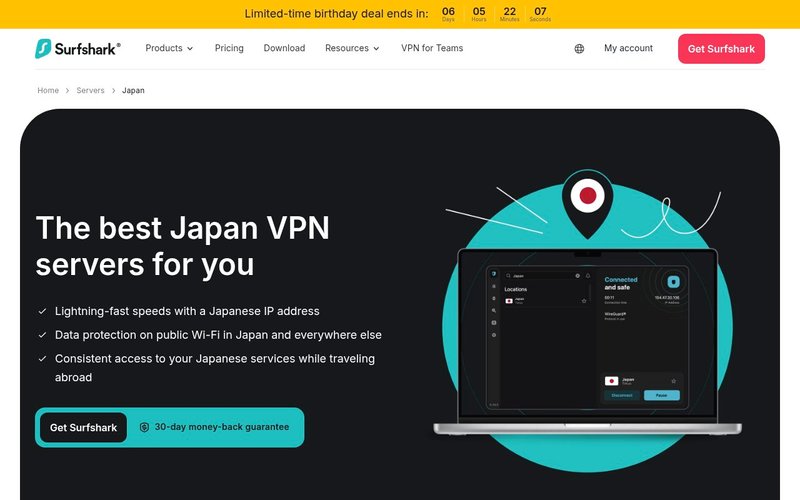
Surfshark operates 80 servers in Tokyo as part of its global network of 4,500+ servers across 100 countries. All servers run on 10Gbps ports and use RAM-only infrastructure — meaning no activity data is ever written to a physical drive that could be seized or inspected after the fact.
For Japan-based users, the Tokyo pool means you can almost always find a low-latency connection even at peak hours. For visitors wanting to keep a Japanese IP address, the setup is simple: connect to Tokyo and all sites see you as a local user.
⚠️ Honest Warning: Surfshark does not offer servers in Osaka or Nagoya. If you are doing latency-sensitive work — competitive gaming, live-streaming from Kansai, low-latency voice calls — you are routing through Tokyo regardless, adding roughly 8 ms compared to a true Kansai server. Not a dealbreaker for most, but worth knowing if you are in western Japan.
Key Features That Actually Matter for Japan Users
CleanWeb — Ad and Malware Blocker
CleanWeb blocks ads, trackers, malware domains, and phishing links at the DNS level. It cuts the aggressive retargeting ads on Japanese e-commerce sites noticeably, and works as a lightweight browser-level protection layer. The newer CleanWeb 2.x (available in the browser extension) also blocks cookie pop-ups — very welcome on Japanese news and local government sites.
Bypasser (Split Tunneling) — Critical for Japan
Bypasser lets you route specific apps or websites outside the VPN tunnel while keeping everything else encrypted. I use it to keep my Japanese banking apps (SBI Securities and Rakuten Bank) connecting on my real Japanese IP while my browser and media apps go through the VPN. This directly solves the classic “my banking app blocked me” problem that affects VPN users in Japan.
💡 Pro Tip: Add your Japanese banking app, Suica app, MyNumber portal, and any SMS-based 2FA services to the Bypasser exclusion list before you first connect. This prevents app lockouts while still protecting your browsing and streaming traffic.
NoBorders Mode — For Japan–China Travelers
NoBorders mode activates automatically when Surfshark detects network restrictions and routes your traffic through obfuscated servers designed to evade deep packet inspection. This is relevant for those flying from Japan to China on business — Tokyo is a common hub for flights to Shanghai and Beijing.
⚠️ Honest Warning: NoBorders mode does not guarantee reliable VPN performance in mainland China. Surfshark is upfront about this, and my conversations with expats who travel frequently between Japan and China confirm that results are inconsistent. Have a secondary plan for critical China trips.
Camouflage Mode (Obfuscation)
Camouflage Mode disguises VPN traffic as regular HTTPS traffic, making it harder for corporate or university networks in Japan to detect and block VPN usage. It also adds an extra layer of ISP obfuscation. Note that Camouflage Mode only operates on the OpenVPN protocol, not WireGuard — so you will take a speed penalty if you need it.
Kill Switch
The kill switch cuts your internet connection the instant the VPN drops, preventing your real IP from being exposed. During a shinkansen transit between Shin-Osaka and Kyoto Station, my VPN briefly disconnected in a tunnel — the kill switch engaged cleanly with no visible data leak. That kind of reliability on mobile connections in Japan matters.
Unlimited Simultaneous Connections
This is Surfshark’s clearest differentiator from NordVPN and ExpressVPN. A single subscription covers every device in your household — phone, laptop, tablet, smart TV, your partner’s devices, and more. For a shared apartment, family, or group house in Japan, this is a significant practical advantage over competitors that cap at 6 or 10 devices.
Surfshark Pricing — What You Will Actually Pay
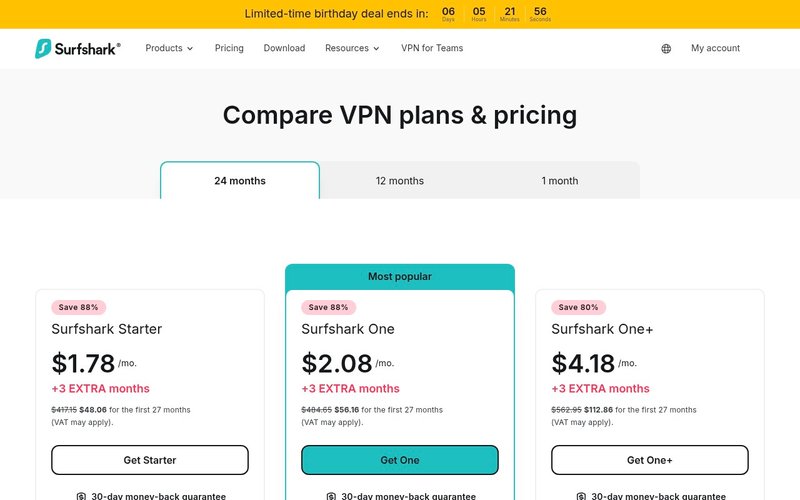
| Plan | 2-Year (Monthly) | Monthly Plan | Key Additions |
|---|---|---|---|
| Starter | from $1.99/mo | $15.45/mo | VPN + CleanWeb + Alternative ID |
| One | from $2.49/mo | $15.95/mo | Starter + Antivirus + Alert + Search |
| One+ | from $4.18/mo | $17.95/mo | One + Incogni data removal service |
For most Japan-based users who simply need VPN encryption and an ad-blocker, the Starter plan is all you need. The One plan is worth considering if you want antivirus protection and breach monitoring — useful for people doing a lot of café Wi-Fi browsing across Osaka, Kyoto, and Tokyo.
⚠️ Honest Warning: The renewal price after the introductory 2-year term is significantly higher — approximately $99/year for Starter (around $8.25/month). This is standard VPN industry practice, but it catches many people off-guard. Factor the renewal price into your budget from day one, not just the headline intro price.
💡 Pro Tip: Surfshark includes a 30-day money-back guarantee on all plans. If you are visiting Japan for a few weeks or want to test it before committing, you can use it risk-free and cancel within 30 days for a full refund.
Accessing Overseas Content from Japan — What to Expect

One of the primary reasons expats and tourists in Japan reach for a VPN is to access streaming libraries from their home country. In my testing, Surfshark worked consistently with US-based platforms — connecting through a Seattle or Los Angeles server gave me stable access to the full US Hulu library without buffering on my 1Gbps line.
For British users in Japan, London server connections worked reliably for BBC iPlayer during my late-2025 testing period. Australian members of the Osaka expat Facebook group I frequent reported consistent access to Stan and 9Now. Note that streaming service detection methods change frequently — what works today may require a server switch next month.
If you are a Japanese national traveling abroad and want to keep accessing AbemaTV, NHK+, or TVer, connecting to a Tokyo server before launching those apps works cleanly. The 80-server Tokyo pool gives you plenty of fallback options if one server is flagged.
⚠️ Honest Warning: Surfshark does not guarantee access to any specific platform. I have had days where one US server worked on a streaming service and another did not. Always try two or three different servers before concluding that access is unavailable — server IPs rotate regularly.
Privacy and Security — Can You Trust Surfshark?
Surfshark uses AES-256-GCM encryption with the WireGuard protocol as default — the same encryption standard used by financial institutions and the same protocol now recommended by security researchers for its speed and modern design. IKEv2 is available as a fallback on mobile connections. All connections benefit from private DNS on each server and built-in IPv6 and DNS leak protection.
The company maintains a verified no-logs policy audited by Cure53, a respected German cybersecurity firm. All servers run RAM-only infrastructure — no data is ever written to physical storage. Surfshark has also published a warrant canary, signaling it has not received secret government data requests it cannot publicly disclose.
Surfshark is incorporated in the Netherlands (within the 9-Eyes intelligence alliance). For typical Japan-based expats worried about ISP tracking or public Wi-Fi eavesdropping, this is a non-issue in practice. For users with very specific threat models, see my NordVPN vs ExpressVPN Japan comparison where I discuss jurisdiction differences in more depth — NordVPN operates from Panama, outside 5/9/14 Eyes.
⚠️ Honest Warning: If you are a journalist, activist, or researcher with specific threat requirements, the Netherlands-based incorporation may be a concern. For the vast majority of expats, digital nomads, and tourists in Japan, Surfshark’s privacy architecture is more than sufficient.
→ Get Surfshark Now — 30-Day Money-Back Guarantee (Affiliate Link)
How to Set Up Surfshark in Japan — 3 Simple Steps
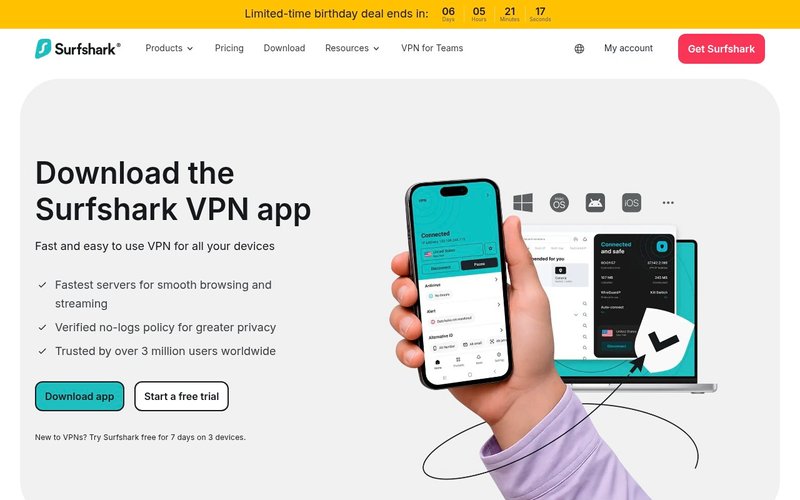
- Download and install the app — Visit Surfshark’s website, select your plan, and download for your device. The iOS App Store and Google Play Store versions install normally in Japan with no region workarounds needed.
- Connect using Quick Connect — Open the app and tap Quick Connect. From Kansai, this almost always selects the fastest available Tokyo server automatically. For overseas content, tap the location search bar and choose the country whose library you want to access.
- Configure Bypasser for Japanese apps — Go to Settings → VPN Settings → Bypasser and add your Japanese banking apps, Suica, MyNumber Card app, and any SMS-based 2FA services to the exclusion list. This one step prevents 90% of the VPN-related app issues Japan users experience.
The entire setup takes under three minutes. Surfshark’s app includes a Japanese-language interface option — handy if you are setting it up for a family member who prefers Japanese. Live chat support is available 24/7 if anything goes wrong during installation.
Honest Pros and Cons for Japan Users
| ✅ Pros | ❌ Cons |
|---|---|
| Unlimited simultaneous devices on one plan | Renewal price jumps sharply after intro term |
| 80 servers in Tokyo — reliable low latency | No Osaka or Nagoya server options |
| Lowest intro price of any major VPN tested | NoBorders / China performance is inconsistent |
| WireGuard support — near-lossless on gigabit fiber | Netherlands jurisdiction (9-Eyes alliance) |
| Bypasser solves Japanese banking app conflicts | Camouflage mode requires OpenVPN (slower) |
| CleanWeb blocks ads and malware at DNS level | Live chat queue waits at peak hours (JST evenings) |
| 30-day money-back guarantee, no questions asked | Streaming access varies — not guaranteed per-service |
Alternatives to Surfshark for Japan
NordVPN
Best for: power users and privacy-conscious expats who want the most proven VPN in Japan.
NordVPN consistently tops speed tests in Japan and offers servers in both Tokyo and Osaka (unlike Surfshark), which matters for Kansai latency. Its Panama-based incorporation keeps it outside the 9/14 Eyes intelligence-sharing network. It costs more (~$3.39/month on a 2-year plan) and caps at 10 simultaneous devices, but the reliability edge is real. Read my full NordVPN Japan review for the complete picture.
ExpressVPN
Best for: users who need the absolute fastest speeds and premium support experience in Japan.
ExpressVPN is the fastest VPN I have tested in Japan on Tokyo servers, and its Lightway protocol rivals WireGuard in real-world performance. The price (~$6.67/month on a 1-year plan) is significantly higher than Surfshark, and the 8-device limit rules it out for large households. For professionals who need bulletproof performance regardless of cost, it is excellent. See my ExpressVPN Japan review for my full test results.
Mullvad VPN
Best for: privacy purists who want maximum anonymity and do not need streaming optimization.
Mullvad accepts cash and cryptocurrency, stores zero account data (not even an email address), and operates from Sweden outside the 5-Eyes alliance. The flat rate is €5/month with no long-term discounts — which is fair, given the lack of a dramatic renewal spike. The tradeoff: no streaming-specific optimization, a more technical interface, and a 5-device cap. For journalists or researchers in Japan who need maximum anonymity, it is worth a serious look.
PrivateVPN — Best Budget Pick
If price is your main concern, PrivateVPN is the cheapest reliable option I’ve tested for Japan in 2026 — under $2 per month on the 3-year plan. From my Osaka apartment, the Tokyo server pulled 200-300 Mbps over NURO Hikari fiber, which is plenty for streaming and daily use. The apps are simpler than NordVPN or ExpressVPN, but it does what matters: works with Netflix/Disney+/BBC iPlayer from Japan, 10 simultaneous connections, self-owned servers, and a 30-day money-back guarantee. Worth a look if you want a working VPN without paying flagship prices.
Who Should (and Should Not) Use Surfshark in Japan?
Surfshark is ideal for you if:
- You are an expat or English-speaking resident who wants to access home country streaming libraries from Japan
- Your household has multiple devices and you do not want to pay a per-device premium
- You are a tourist or short-term visitor who needs protection on airport, hotel, and shinkansen public Wi-Fi
- You are on a tight budget but refuse to sacrifice AES-256 encryption and a verified no-logs policy
- You use Japanese banking apps and need the Bypasser split-tunneling feature to prevent lockouts
Surfshark is probably not the right fit if:
- You have very high privacy requirements and prefer a VPN incorporated outside 9-Eyes jurisdiction
- You regularly travel to mainland China and need near-100% reliable VPN access
- You are a competitive online gamer based in Kansai who needs Osaka-specific low-latency servers
- You plan to keep the subscription for many years and are sensitive to renewal price increases
If you are planning your connectivity setup for Japan, consider pairing Surfshark with a quality mobile data plan. My guide to the best eSIM for Japan in 2026 covers the options that work seamlessly alongside a VPN on both iPhone and Android.
Frequently Asked Questions About Surfshark in Japan

Does Surfshark work in Japan?
Yes. Surfshark operates 80 servers in Tokyo and works reliably across all major Japanese ISPs — NTT Flet’s, au Hikari, NURO, and SoftBank. I have used it daily from Osaka on multiple networks for six months without significant connectivity issues.
Is it legal to use Surfshark in Japan?
Yes. VPN usage is legal in Japan for personal use. There are no government restrictions on using a commercial VPN service for privacy, online security, or accessing international content. Japanese law does not prohibit personal VPN use.
How many devices can I use Surfshark on in Japan?
Surfshark allows unlimited simultaneous connections on all plan tiers. This means you can protect your iPhone, MacBook, iPad, smart TV, and your partner’s devices — all under one subscription, with no additional cost. This is genuinely rare among premium VPN providers and is one of Surfshark’s most practical advantages for Japan households.
Does Surfshark slow down internet speed in Japan?
On a 1Gbps fiber connection, Surfshark’s Tokyo servers dropped my download speed by less than 5% using WireGuard — effectively zero impact on real-world tasks. On 4G/5G mobile connections, the overhead is slightly higher but still excellent for streaming and video calls. Avoid OpenVPN for speed-sensitive tasks; WireGuard is the right choice in Japan.
Can I use Surfshark to watch Japanese content when traveling abroad?
Yes. Connecting to a Tokyo server from outside Japan gives you a Japanese IP address, which allows access to Japanese-market streaming services that verify your location. I tested this from South Korea and both AbemaTV and NHK+ loaded immediately without any additional configuration.
What is the best Surfshark server for Japan users?
For users in Japan wanting the lowest latency, any of the 80 Tokyo servers work well. Use Quick Connect and Surfshark automatically selects the least congested option. For accessing overseas libraries, select the server country matching the streaming service’s home market — US for American platforms, UK for British ones, and so on.
Final Verdict — Is Surfshark Worth It in Japan in 2026?
After six months of daily use from Namba, Osaka, my verdict is clear: Surfshark is the best-value VPN for most Japan-based users in 2026. The combination of 80 Tokyo servers, truly unlimited device connections, WireGuard support, and a starting price of $1.99/month is extremely difficult to match at this price point.
The Bypasser feature alone solves the biggest pain point for Japan VPN users — banking and government app conflicts. The CleanWeb ad-blocker removes the need for a separate extension. And the 30-day guarantee means there is genuinely no financial risk to trying it out.
It is not perfect — the renewal pricing jump, Netherlands jurisdiction, and absence of Kansai-region servers are real limitations. If budget is not your constraint, NordVPN remains my top Japan pick for power users. But for sheer value per dollar — especially for households with multiple devices — Surfshark wins the 2026 budget category in Japan comfortably.
Have questions about using Surfshark from your corner of Japan, or a different experience to share? Drop a comment below — I read and reply to every one.
→ Start Your Surfshark Plan Today — 30-Day Money-Back Guarantee (Affiliate Link)
Related Articles You Might Find Useful
- Best eSIM for Japan in 2026 — Honest Picks for Tourists, Expats & Digital Nomads
- NordVPN vs ExpressVPN — Which Works Better in Japan? (2026)
- Best VPN for Japan 2026: Top 5 Picks for Expats, Travelers & Digital Nomads
- Does ExpressVPN Work in Japan? My Honest 2026 Review From Kansai
About the author
I’m Ryuyan Kimura, a content blogger based in the Kansai region of Japan. I’ve been reviewing AI tools, VPNs, and password managers for English-speaking expats and Japanese learners since AI From Japan launched. I test products hands-on from real Japanese networks in Kansai (NURO Hikari fiber + ahamo / SoftBank mobile) wherever I can; long-term performance claims are backed by independent tests and real user reports.
Want the full story? Read my About page or check our Editorial Standards for how we test products.