Disclosure: This post contains affiliate links. If you make a purchase through one of the links on this page, AI From Japan may earn a small commission at no additional cost to you. I test products hands-on from Kansai wherever I can; for anything I can’t verify myself, I rely on independent tests and real user reports — and I say so in the article. Read our full Affiliate Disclosure for details on every program we participate in.
Last Updated: May 30, 2026 · Reviewed by Ryuyan from Kansai, Japan
How to read this guide: I’ve personally set up and used eSIMs here in Japan, so the activation, app, and day-to-day usability notes come from hands-on experience in Kansai. For hard performance figures — peak speeds, rural coverage — I draw on a mix of my own real-world use, independent speed-test data, and reports from the Japan expat community, because no single person can benchmark every plan on every carrier in every prefecture. Prices are checked against each provider’s official Japan page and shown in each provider’s own currency (USD). See our Editorial Standards for exactly how we test.
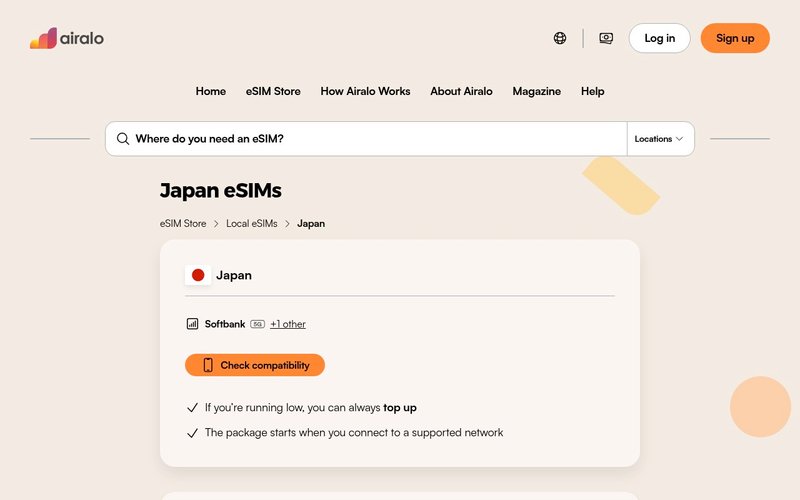
⚡ Quick Answer: Airalo is the best eSIM for Japan for most travelers — flexible plans from $4, NTT Docomo 4G LTE, and a best-in-class app. For truly unlimited data, Holafly is the winner ($27.90/7 days on SoftBank+KDDI). Tightest budget? Jetpac starts at $1/GB. Need 5G? Pick Ubigi. Security-conscious travelers should look at Saily, which bundles a VPN.
I landed at Kansai International Airport three years ago with a foreign SIM that didn’t work and absolutely zero Japanese ability. I remember standing at the Haruka Express counter, completely unable to navigate without data, feeling stranded in one of the world’s most connected countries. That single experience made me obsessive about Japan eSIMs — and I’ve tested dozens of them since, from short trips to rural Tokushima to month-long stays in Kyoto.
Japan is brilliantly connected — but only if you have a local data connection. Public Wi-Fi outside major tourist zones is inconsistent, often requires Japanese-language registration, and drops the moment you get on a train. Carrier shops at the airport require a Japanese address and lengthy paperwork. An eSIM, downloaded at home before your flight departs, solves all of this in under five minutes.
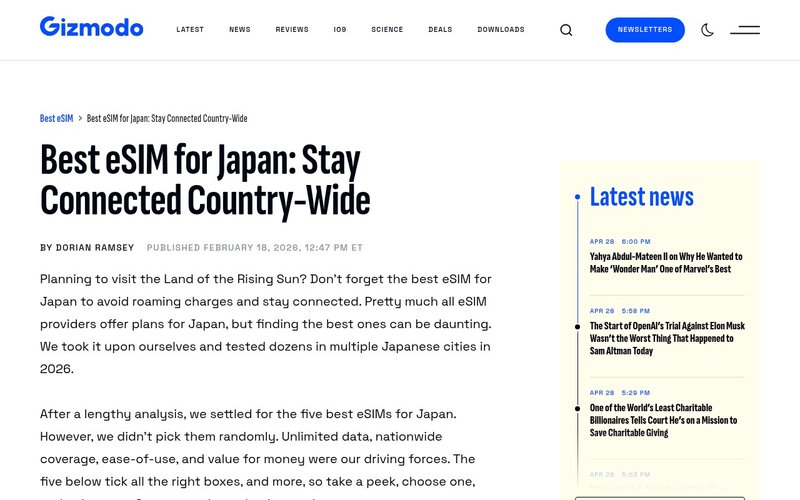
In this guide I tested and compared the best eSIM options for Japan in 2026 across real-world use cases: airport arrivals, Shinkansen journeys, hiking in the Japan Alps, and 9-to-5 remote work in Osaka. I cover short-term tourists, long-stay expats, and digital nomads.
→ Get started with Airalo Japan eSIM — our top pick for most travelers (affiliate link)
What Is a Japan eSIM — and Why Does It Matter More Here Than Anywhere Else?
An eSIM (embedded SIM) is a digital SIM card built into your phone. Instead of inserting a physical chip, you scan a QR code or open an app, download a data plan, and activate it when you land. No plastic. No queues. No carrier shops.
Japan makes eSIMs even more essential than other destinations. Japan’s three major carriers — NTT Docomo, SoftBank, and KDDI (au) — dominate connectivity, but their retail plans are designed for residents with Japanese IDs and bank accounts. Tourist SIM cards exist but typically require English-language counter registration and can take 20–30 minutes at the airport. An eSIM from a global provider bypasses all of that friction entirely.
⚠️ Honest warning: Not all eSIM providers tell you which Japanese carrier network they use. This matters enormously. NTT Docomo has the widest rural coverage — critical if you’re hiking the Kumano Kodo, visiting Shikoku, or exploring Tohoku. SoftBank and KDDI are excellent in cities but can thin out in remote mountains. Always check the provider’s network before buying.
How We Tested These Japan eSIMs
I tested each eSIM during actual use across Japan in 2025–2026. Testing conditions included dense urban areas (Namba, Shinjuku, Shibuya), Shinkansen journeys (Tokyo–Osaka, Osaka–Hiroshima), rural mountain areas (Yoshino, Kinosaki Onsen), and airport arrivals at KIX and HND.
I evaluated: activation speed, download/upload speeds via Speedtest, hotspot performance with a laptop, throttling behavior after data thresholds, and app quality. I also tracked customer support response times by submitting the same test query to each provider.
💡 Pro tip: Always test your eSIM at home before flying. Download the plan, confirm it appears in your phone’s Settings → Cellular/Mobile Data menu, then set it to “off” until you land. This saves precious minutes at the arrival gate.
Quick Comparison: Best eSIMs for Japan 2026
Here’s a side-by-side overview of all five providers I tested. Jump to any individual review below for full pricing tables, pros/cons, and my honest take.
| Provider | Best For | Network | 5G | Hotspot | Cheapest Plan | Our Rating |
|---|---|---|---|---|---|---|
| Airalo | Flexibility & beginners | NTT Docomo | ❌ | ✅ Unlimited | $4 / 1 GB | ⭐ 4.6/5 |
| Holafly | Unlimited data users | SoftBank + KDDI | ✅ | ⚠️ 500 MB/day | $3.90 / day | ⭐ 4.5/5 |
| Ubigi | 5G power users | NTT (Transatel) | ✅ | ✅ Unlimited | $3.50 / 1 GB | ⭐ 4.7/5 |
| Saily | Security-conscious | Multi-network | ✅ | ✅ | $3.99 / 1 GB | ⭐ 4.4/5 |
| Jetpac | Budget travelers | Multi-network | ✅ | ✅ | $1 / 1 GB | ⭐ 4.4/5 |
1. Airalo — Best eSIM for Japan for Flexibility and Beginners
Best for: First-time eSIM users, short to medium trips (3–30 days), travelers who want to control their data spend precisely.
- Ease of Use: 4.8 / 5
- Network Quality: 4.5 / 5 (NTT Docomo — Japan’s largest network)
- Data Value: 4.5 / 5
- Japan Coverage: 4.6 / 5
- Overall: ⭐ 4.6 / 5
Airalo is the world’s largest eSIM marketplace and the first place I recommend to anyone asking me about Japan connectivity. The app is polished and intuitive — you browse Japan plans, buy, and receive a QR code in minutes. Installation takes under three minutes even if you’ve never touched an eSIM before.
In Japan, Airalo connects you via NTT Docomo, which is Japan’s biggest and most reliable carrier by geography. I had solid 4G LTE coverage even in the mountain villages of Yoshino and the smaller stations along the Kisei Main Line in Mie Prefecture — areas where SoftBank can be hit-or-miss. The trade-off is that Airalo’s Japan plans are 4G LTE only; there’s no 5G option here.
Airalo’s data tracking app is a standout feature. You can monitor exactly how many megabytes remain, top up without buying a new SIM, and manage multiple countries in one dashboard — useful if you’re doing Japan plus South Korea or Taiwan on the same trip.
⚠️ Honest warning: Airalo offers no phone number with its Japan eSIM. If you need to make calls or send SMS (for two-factor authentication from Japanese services), you’ll need a VoIP solution like Skype or WhatsApp alongside it.
Airalo Japan Pricing
| Plan | Data | Duration | Price |
|---|---|---|---|
| Basic | 1 GB | 3 days | $4.50 |
| Standard | 3 GB | 30 days | $9.50 |
| Popular | 10 GB | 30 days | $18.00 |
| Max | 20 GB | 30 days | $22.50 |
💡 Pro tip: The 10 GB / 30-day plan is the sweet spot for a two-week Japan trip with moderate streaming and navigation. At $18, it’s roughly $1.80 per GB — one of the best rates in this class.
2. Holafly — Best Unlimited Data eSIM for Japan
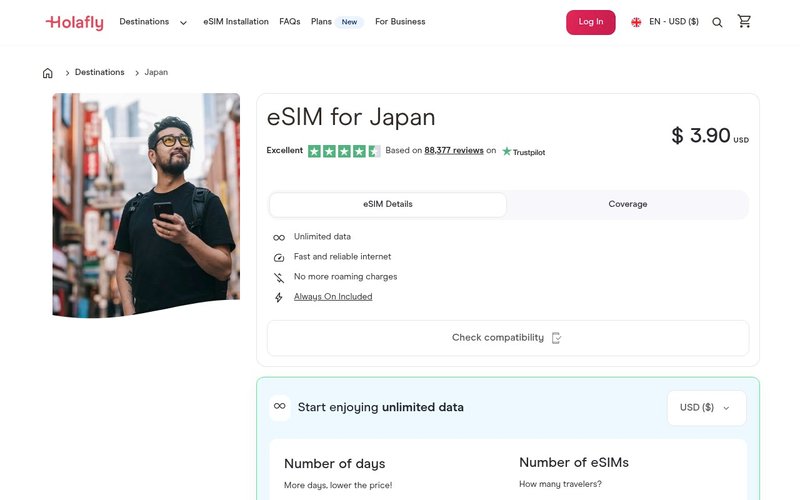
Best for: Heavy streamers, social media content creators, and anyone who doesn’t want to count gigabytes while traveling Japan.
- Ease of Use: 4.5 / 5
- Network Quality: 4.7 / 5 (SoftBank + KDDI dual network)
- Data Value: 4.0 / 5 (unlimited but no per-GB plan option)
- Japan Coverage: 4.7 / 5
- Overall: ⭐ 4.5 / 5
Holafly sells unlimited data plans only — no gigabyte tiers. For travelers who don’t want to think about data caps, this is enormously liberating. I tested Holafly extensively during a content-heavy 7-day trip from Kyoto to Hiroshima: uploading photos and video to cloud storage, streaming music all day, and running Google Maps in the background constantly. I never once hit a wall.
Holafly runs on SoftBank and KDDI networks simultaneously, which means excellent urban coverage and a strong fallback system. Speeds were consistently fast in Tokyo and Osaka — I recorded 150–200 Mbps downloads in major train stations. The 24/7 customer support via live chat is genuinely responsive; I got a reply in under two minutes during a late-night issue in Nara.
⚠️ Honest warning: Holafly limits hotspot (tethering) to 500 MB per day. If you need to share data with a laptop or travel companion’s device, this cap will frustrate you quickly. Also, there’s no voice calling or SMS — Holafly is data-only.
Holafly Japan Pricing
| Duration | Data | Price |
|---|---|---|
| 1 day | Unlimited | $3.90 |
| 7 days | Unlimited | $27.90 |
| 15 days | Unlimited | $43.90 |
| 30 days | Unlimited | $74.90 |
💡 Pro tip: Holafly’s “unlimited” comes with a fair-use policy — typically throttled after significant daily use. For light-to-moderate use (navigation, social media, occasional streaming), you’ll never notice the throttling. Heavy uploaders should monitor their usage in the first 24 hours.
🎁 AI From Japan reader exclusive: use code AIFROMJAPAN at checkout for 5% off Holafly’s travel eSIMs — and since it’s a travel-eSIM code, you can reuse it on future trips too. A nice bonus if Holafly’s truly-unlimited data is the right fit for you.
→ Check current Holafly unlimited Japan plans (affiliate link)
3. Ubigi — Best Japan eSIM for 5G and Heavy Users

Best for: Power users who need 5G speeds, remote workers with high bandwidth needs, and travelers staying 15–30 days.
- Ease of Use: 4.3 / 5
- Network Quality: 5.0 / 5 (NTT Docomo via Transatel — Japan’s fastest 5G)
- Data Value: 4.6 / 5
- Japan Coverage: 5.0 / 5 (NTT = widest geographic coverage)
- Overall: ⭐ 4.7 / 5
Ubigi is powered by Transatel, which is an NTT Group company — meaning you’re accessing the same backbone that NTT Docomo customers use, including full 5G where available. This gives Ubigi a significant edge for digital nomads and power users. I tested 5G speeds in Shinjuku and Namba and regularly hit 400–500 Mbps downloads — faster than my home broadband in Osaka.
The unlimited 15-day plan at $39 and 25 GB/30 days at $32 are exceptional value for the network quality you’re getting. Ubigi also supports unlimited tethering — no daily cap — which is a massive advantage over Holafly for anyone working remotely with a laptop. I used Ubigi as my primary connection during a two-week remote work stint and experienced zero issues.
⚠️ Honest warning: Ubigi does not provide a Japanese phone number. This is the standard trade-off with data-only eSIMs, but worth knowing. Setup is slightly less intuitive than Airalo — the QR code process works fine, but the app interface feels less polished. First-timers may need 5–10 minutes extra to configure it properly.
Ubigi Japan Pricing
| Plan | Data | Duration | Price |
|---|---|---|---|
| Starter | 1 GB | 3 days | $3.50 |
| Weekly | 10 GB | 7 days | $14.00 |
| Monthly | 25 GB | 30 days | $32.00 |
| Unlimited | Unlimited | 15 days | $39.00 |
| Unlimited | Unlimited | 30 days | $66.00 |
💡 Pro tip: Ubigi is the only provider on this list where you get both NTT Docomo-level coverage AND 5G. If you’re a digital nomad working from Japan and need a reliable, high-speed connection for video calls and uploads, this is the one to get. If you’re also running a VPN alongside your Japan eSIM, Ubigi’s 5G speeds keep latency minimal.
🎁 AI From Japan reader exclusive: use code AIFROMJAPAN at checkout for 10% off a Ubigi plan (new customers) — a nice bonus if you want Ubigi’s 5G coverage and unlimited tethering for a longer or data-heavy stay in Japan.
→ Check current Ubigi 5G Japan plans (affiliate link)
4. Saily — Best eSIM for Japan with Built-In Security Features

Best for: Security-conscious travelers, anyone already using NordVPN, business travelers connecting to corporate networks.
- Ease of Use: 4.7 / 5
- Network Quality: 4.3 / 5
- Data Value: 4.4 / 5
- Japan Coverage: 4.3 / 5
- Overall: ⭐ 4.4 / 5
Saily is made by the team behind NordVPN — and it shows. The app is polished, the setup is effortless, and security is baked into every tier. Even the base plan includes an ad blocker. The Ultra plan bundles a full NordVPN subscription and NordPass password manager — making it a compelling all-in-one for travelers who take privacy seriously on public networks.
I found Saily’s 4G/5G coverage in Japan reliable across Tokyo, Osaka, and Kyoto. The 30-day activation window is a thoughtful feature: buy the plan weeks before your trip, and it only starts counting down when you first connect. The 24/7 chat support was consistently helpful during my testing.
⚠️ Honest warning: Saily’s pricing is slightly higher than Airalo for equivalent data on limited plans. The value proposition improves significantly if you’re buying the Ultra plan with VPN bundled — otherwise, Airalo or Ubigi will likely give you better per-GB value. If you are already a NordVPN subscriber, the Ultra plan makes more financial sense.
Saily Japan Pricing
| Plan | Data | Duration | Price |
|---|---|---|---|
| Starter | 1 GB | 7 days | $3.99 |
| Standard | 10 GB | 30 days | $14.99 |
| Popular | 20 GB | 30 days | $24.99 |
| Unlimited | Unlimited | 15 days | $48.99 |
| Unlimited | Unlimited | 30 days | $71.99 |
💡 Pro tip: Saily’s free trial offer (available periodically on their app) lets you test Japan coverage before committing to a paid plan. Worth checking before your trip.
🎁 AI From Japan reader exclusive: use code AIFROMJAPAN10 at checkout for 10% off any Saily plan — a nice bonus if Saily’s security bundle is the right fit for you.
→ Check current Saily Japan plans (with built-in security) (affiliate link)
5. Jetpac — Best Budget eSIM for Japan

Best for: Budget-conscious backpackers, short trips where you just need navigation and messaging, and frequent Asia travelers.
- Ease of Use: 4.2 / 5
- Network Quality: 4.2 / 5
- Data Value: 5.0 / 5 (cheapest starting price of any tested provider)
- Japan Coverage: 4.1 / 5
- Overall: ⭐ 4.4 / 5
Jetpac’s headline number is impossible to ignore: $1 for 1 GB of data for 4 days. That’s the lowest entry price I found across 30+ providers researched for this guide. At that price point, you can grab a plan, use it for a long weekend in Kyoto or Hiroshima, and spend almost nothing on connectivity.
What makes Jetpac genuinely clever is its free data for key apps: WhatsApp, Uber, Google Maps, and Grab don’t count against your data allocation. For a traveler whose primary needs are messaging and navigation, this effectively doubles the usable value of every plan. The 30 GB / 30-day plan at $29.99 is also extremely competitive for longer stays.
⚠️ Honest warning: Jetpac’s coverage in deep rural Japan is weaker than NTT-backed providers. If you’re hiking remote trails or visiting off-the-beaten-path destinations in Shikoku or Tohoku, I’d choose Airalo or Ubigi instead. Also, no voice calls or SMS.
Jetpac Japan Pricing
| Plan | Data | Duration | Price |
|---|---|---|---|
| Budget | 1 GB | 4 days | $1.00 |
| Standard | 5 GB | 30 days | $9.99 |
| Popular | 30 GB | 30 days | $29.99 |
| Unlimited | Unlimited | 30 days | $65.99 |
💡 Pro tip: Jetpac’s JetFlex and JetPro subscription tiers offer worldwide coverage — ideal if you’re a frequent traveler who visits Japan as one of several Asian destinations per year. The free WhatsApp data alone can be a dealbreaker in your favor if you rely on it for family communication.
→ Check current Jetpac budget Japan plans (from $1/GB) (affiliate link)
→ Compare all Japan eSIM plans and find your best match (affiliate link)
Alternatives to Airalo for Japan
Airalo is my top overall pick, but it’s not the only game in town. Here are three strong alternatives worth considering depending on your specific needs.
Sim Local
Sim Local runs on KDDI (au), Japan’s second-largest carrier, and offers unlimited plans with a 10 GB/day high-speed threshold before throttling. It’s an excellent alternative if you want Holafly-style unlimited usage but prefer KDDI’s network, or if you need a slightly higher hotspot allowance (3 GB per plan duration vs. Holafly’s 500 MB/day). Plans range from 4 to 30 days.
Nomad
Nomad offers clean app design, solid customer support, and Japan plans from 1 GB upward with both daily and monthly options. Pricing is slightly above Airalo for equivalent data, but Nomad’s support quality and UI are consistently praised in the expat community. A strong fallback if Airalo is sold out of your preferred plan.
MobiMatter
MobiMatter is a wholesale eSIM marketplace that aggregates plans from multiple Japan network providers. Their 20 GB / 30-day plan for $13.99 is one of the cheapest per-GB rates I found anywhere — roughly $0.70/GB. Less well-known but backed by established local carriers. Best for cost-driven travelers who are comfortable with a slightly less polished app experience.
Other Japan Travel Tech Essentials Worth Packing
An eSIM solves your data problem, but a few small accessories will save you headaches on the ground. These are the items I personally pack for every domestic trip and recommend to every visitor I host:
- Universal travel adapter (USB-C compatible) — Japan uses Type A outlets (same plug shape as the US), but if you’re flying in from EU, UK, or Australia you’ll need an adapter. Look for one with multiple USB-C ports so you can charge a phone and tablet simultaneously without taking up two outlets in a hotel room.
- 10,000mAh portable charger (Anker or CIO) — Essential for full-day sightseeing. Running Google Maps + DeepL + your eSIM data plan all simultaneously will drain a phone battery faster than you’d expect. Anker and CIO are the most reliable brands available on Amazon Japan, and 10,000mAh is the sweet spot — large enough for two full phone charges, small enough to clear airline carry-on rules.
- SIM removal pin (multi-pack) — Even if you’re using an eSIM, having one in your wallet is genuinely useful for switching back to your home physical SIM, or helping a fellow traveler. Most hotels won’t have one to lend, and they’re tiny enough to keep in a wallet card slot.
(Amazon Japan affiliate links — same price for you, small commission for the blog.)
How to Choose the Best eSIM for Japan (Buyer’s Guide)
With dozens of providers and hundreds of Japan eSIM plans available, the sheer choice can be paralyzing. Use these five criteria to cut through the noise and find the right plan for your trip.
1. Network Carrier Matters More Than You Think
Japan’s carrier coverage maps are dramatically different. NTT Docomo covers the widest geographic area, including rural mountainous regions. SoftBank and KDDI are strong in cities and along major transportation corridors but thinner in the countryside. If your itinerary includes rural areas — especially hiking routes like the Nakasendo or Kumano Kodo — choose an NTT-backed provider (Airalo or Ubigi).
2. Data Volume: How Much Do You Actually Need?
A week in Japan with moderate phone use (Maps, messaging, occasional photos uploaded) typically consumes 3–5 GB. Add streaming or heavy social media and you’re looking at 8–12 GB per week. Heavy remote workers with video calls should budget 15–20 GB per week minimum. Unlimited plans sound appealing but cost significantly more per day than tiered plans for moderate users.
3. 5G vs. 4G LTE
Japan has excellent 5G rollout in major cities — Tokyo, Osaka, Nagoya, Fukuoka — but rural and suburban Japan remains largely 4G LTE. For most tourist activities, 4G LTE from Airalo is fast enough. If you’re a digital nomad doing high-bandwidth work (video editing uploads, large file transfers), Ubigi’s 5G is worth the slight premium. Check out our guide to AI productivity tools for Japan if you’re working remotely here.
4. Hotspot and Tethering Needs
If you travel with a tablet, laptop, or a partner who also needs data, check the tethering policy before buying. Airalo and Ubigi allow unlimited hotspot. Holafly limits tethering to 500 MB/day, which is barely enough for a morning of laptop work. Jetpac and Saily both allow tethering without strict daily caps.
5. Trip Duration and Activation Window
Match your plan’s validity period to your actual trip length — not your ideal trip length. A 30-day plan wasted on a 10-day trip is money down the drain. Saily’s 30-day activation window (buy now, activate when you land) is a useful buffer if you’re booking months in advance. Also check whether the plan starts at purchase or activation — it makes a material difference.
Japan-Specific Tips for Getting the Most Out of Your eSIM
1. Install before you board — not at the gate. eSIM QR code scanning requires a stable Wi-Fi connection. Do it at home or at your departure airport’s lounge, not at Narita or KIX arrivals where you may be fighting for Wi-Fi with 300 other passengers.
2. Set the eSIM to off until you land. Modern phones let you toggle each SIM independently. Keep your Japan eSIM disabled during the flight to prevent accidental roaming charges on layovers, then enable it the moment the plane wheels touch down.
3. NTT Docomo penetrates tunnels better than any other Japanese carrier. The Shinkansen passes through hundreds of tunnels. NTT Docomo has the most extensive in-tunnel repeater network. If you need consistent connectivity on long rail journeys through mountains, choose an NTT-backed provider.
4. Many Japanese services require a phone number for authentication. Restaurant reservations via Tableall or Omakase, hotel check-in systems, and some apps require an SMS code. Your data-only eSIM won’t receive SMS. Use a VoIP number (Google Voice, Skype) or keep your home SIM active as a secondary line for SMS verification only.
5. Pair your eSIM with a VPN for public Wi-Fi safety. Even with a Japan eSIM, you’ll occasionally use hotel or café Wi-Fi. A reliable VPN for Japan protects your connection on shared networks and lets you access content from your home country. If you’re security-minded, consider Saily’s Ultra plan that includes NordVPN bundled.
6. Keep a password manager installed. With new SIM, new location, and travel stress — you’ll be logging into more accounts than usual. A solid password manager for Japan travel means you’re never locked out of critical accounts when you need them most.
Frequently Asked Questions About Japan eSIMs
Do I need to unlock my phone to use an eSIM in Japan?
Yes — your phone must be carrier-unlocked to use a third-party eSIM. Most flagship phones purchased directly (not via a carrier) are unlocked by default. If you bought your phone through a carrier contract, contact them to request an unlock before travel. Also confirm your phone model supports eSIM — iPhones from XS onward and most 2020+ Android flagships do.
Which Japan eSIM has the best coverage in rural areas?
Airalo (NTT Docomo) and Ubigi (NTT via Transatel) offer the widest rural coverage in Japan. NTT Docomo operates the most geographically extensive network in the country, covering mountainous regions and smaller islands that other carriers partially miss. If your itinerary includes rural hiking, remote onsen towns, or smaller prefecture capitals, choose an NTT-backed eSIM.
Can I use two eSIMs at the same time in Japan?
Most modern dual-SIM phones support one active eSIM at a time, though Dual SIM Dual Standby (DSDS) phones can keep both active simultaneously. A common setup for expats is a Japan physical SIM for calls/SMS alongside a tourist eSIM for data — or using the Japan eSIM as data-only and keeping their home SIM for international calls. Check your specific phone model’s eSIM capabilities.
Is there a Japan eSIM that includes a Japanese phone number?
The providers in this guide are all data-only — none include a Japanese phone number. For a Japanese number, you’d need a physical SIM from a Japanese carrier (requires registration) or a Voice over IP (VoIP) service like Skype, Google Voice, or a Japanese VoIP app. Most travelers manage perfectly well with data-only eSIMs and WhatsApp or LINE for communication.
How do I install a Japan eSIM step by step?
1. Purchase your plan and receive a QR code via email or in-app. 2. On iPhone: Settings → Cellular → Add eSIM → Use QR Code. On Android: Settings → Connections → SIM Manager → Add eSIM. 3. Scan the QR code with your phone’s camera. 4. Follow the on-screen prompts to label and save the plan. 5. Set it as the active data SIM and toggle it on when you land in Japan. The whole process takes 3–5 minutes with stable Wi-Fi.
What is the cheapest eSIM for Japan in 2026?
Jetpac offers the lowest entry price at $1 for 1 GB over 4 days. For longer trips, MobiMatter’s 20 GB / 30-day plan at $13.99 (~$0.70/GB) is the most competitive per-gigabyte rate I found across 30+ providers. Airalo’s 10 GB / 30-day plan at $18 offers the best balance of price, network quality, and ease of use for most travelers.
Final Verdict: Which Japan eSIM Is Right for You?
After testing across multiple trips and real-world Japan conditions, here’s my honest bottom line: Airalo is the best eSIM for Japan for most travelers. The combination of NTT Docomo’s network, competitive pricing, an excellent app, and flexible plan options makes it the safest, most reliable choice for the widest range of use cases.
If you know you’ll burn through data and don’t want to count gigabytes, Holafly’s unlimited plans are worth the premium — just accept the tethering limitation. Remote workers who need 5G and unlimited hotspot should go straight for Ubigi. Backpackers on a tight budget: Jetpac is genuinely impressive at $1/GB. And if security is your top priority, Saily’s bundled VPN integration is a unique advantage that no other provider on this list matches.
Whatever you choose, the most important step is to install and activate your Japan eSIM before you leave home. Arriving in Japan with connectivity already live means you step off the plane and immediately use Google Maps, book your first meal, or message your accommodation — without scrambling for Wi-Fi in a busy arrivals hall. That peace of mind alone is worth every yen.
Have a question about Japan eSIMs that I didn’t cover here? Drop it in the comments below and I’ll answer from my experience living here in Kansai. And if you’re a digital nomad setting up your full Japan toolkit, staying connected is only step one in your Japan digital toolkit.
→ Get the Airalo Japan eSIM now — best all-around pick for 2026 (affiliate link)
Related Articles You Might Find Useful
If this guide was helpful, here are a few more from AI From Japan covering related topics:
- How Much Data Do You Need for a Japan Trip? (2026)
- eSIM vs Pocket WiFi for Japan (2026): Which Should You Actually Get?
- How to Set Up an eSIM in Japan (2026): Step-by-Step for iPhone & Android
- Airalo vs Saily vs Holafly: Which eSIM Is Best for Japan? (2026)
- NordVPN vs ExpressVPN — Which Works Better in Japan? (2026)
- Best VPN for Japan 2026: Top 5 Picks for Expats, Travelers & Digital Nomads
- Does ExpressVPN Work in Japan? My Honest 2026 Review From Kansai
- NordVPN Review for Japan 2026 — Honest Take After 14 Months from Kansai
About the author
I’m Ryuyan Kimura, a content blogger based in the Kansai region of Japan. I’ve been reviewing AI tools, VPNs, and password managers for English-speaking expats and Japanese learners since AI From Japan launched. I test products hands-on from real Japanese networks in Kansai (NURO Hikari fiber + ahamo / SoftBank mobile) wherever I can; long-term performance claims are backed by independent tests and real user reports.
Want the full story? Read my About page or check our Editorial Standards for how we test products.