Last Updated: June 30, 2026
Every traveler heading to Japan hits the same fork in the road: eSIM or pocket WiFi? The airport rental counters push pocket WiFi, half the travel blogs scream “eSIM is the future,” and you’re left standing in the Kansai International arrivals hall trying to get Google Maps working before your train leaves.
I run this blog from Osaka, and I get this question more than almost any other. So here’s the honest, no-hype answer — and the honest part matters, because the right pick genuinely depends on your situation. One is not simply “better.” Let me save you the headache.
⚡ Quick Verdict (the 30-second answer)
- Solo traveler or couple with a modern phone? Get an eSIM. Cheaper, instant, nothing to return.
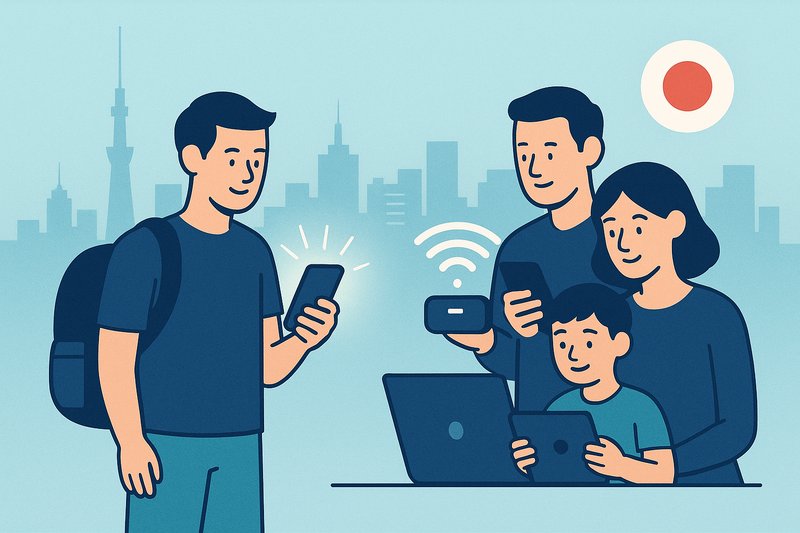
- Family or group of 3+, lots of laptops, or an older/non-eSIM phone? Pocket WiFi still wins — one device covers everyone.
- Want the absolute least hassle and your phone supports eSIM? eSIM, hands down.
If eSIM is your pick, my full breakdown of which eSIM to actually buy for Japan takes it from here.
Check Saily eSIM Prices — 10% off with code AIFROMJAPAN10 →
(affiliate link)
Disclosure: This post contains affiliate links. If you make a purchase through one of the links on this page, AI From Japan may earn a small commission at no additional cost to you. I test products hands-on from Kansai wherever I can; for anything I can’t verify myself, I rely on independent tests and real user reports — and I say so in the article. Read our full Affiliate Disclosure for details on every program we participate in.
What’s actually different between an eSIM and pocket WiFi?
Strip away the jargon and it comes down to one thing: where the connection lives.
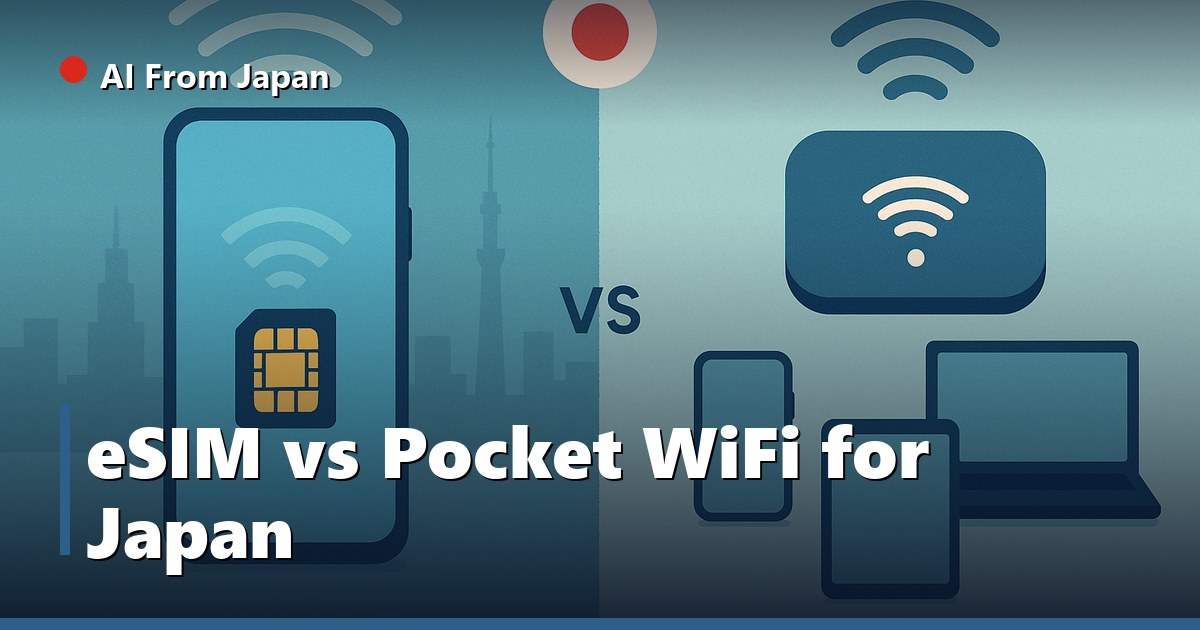
An eSIM (embedded SIM) is a digital SIM card built into your phone. You buy a Japan data plan online, scan a QR code before you fly, and it activates the moment you land. There’s nothing physical — it lives inside your phone, connects straight to a Japanese carrier (docomo, SoftBank or au), and covers that one device.
A pocket WiFi (called poketto waifai here — a portable WiFi router the size of a deck of cards) is a physical gadget you rent. It pulls in a Japanese mobile signal and broadcasts its own WiFi hotspot, so several devices connect to it at once — your phone, your partner’s phone, a laptop, a tablet. You pick it up at the airport or have it delivered to your hotel, then post it back when you leave.
Both are data-only (more on that quirk later), and both ride Japan’s big carrier networks. The difference that actually changes your trip is one device vs. many, and nothing-to-carry vs. a gadget to mind.
The cost: it’s closer than the internet makes it sound
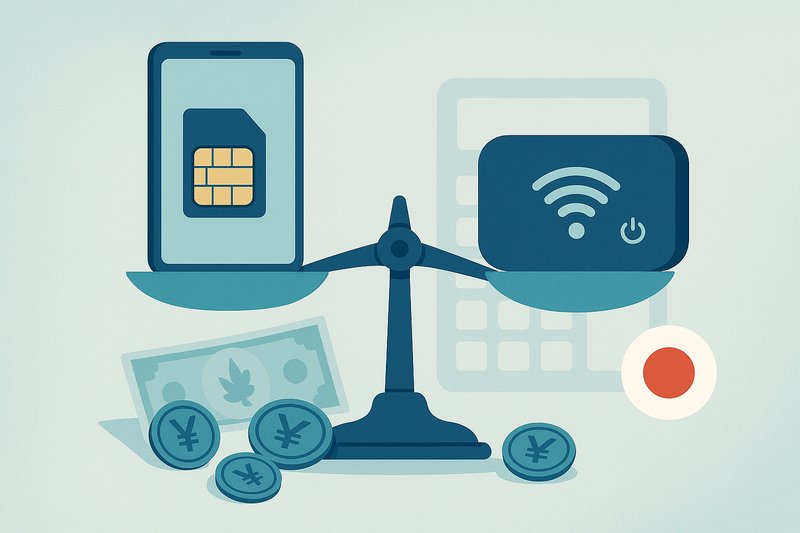
Here’s where the “eSIM is always cheaper” crowd oversimplifies. Rough numbers, checked June 2026 (currency and exact plan move these around, so treat them as ballpark, not gospel):
- Pocket WiFi rental: roughly $5–$10 per day. A 7–10 day trip lands around $35–$80 all-in once you add shipping/pickup and any optional insurance.
- eSIM: a 7-day Japan eSIM with ~10 GB runs roughly $8–$12; bigger 10–20 GB plans sit around $15–$25. Unlimited eSIMs cost more (Holafly’s unlimited is about $27 for a week).
For one or two people, the eSIM is clearly cheaper and simpler. But watch what happens with a group:
A family of four each buying their own eSIM ≈ $60–$100 total. One pocket WiFi shared by all four ≈ $50–$70 — and that single device covers the laptops too. The bigger your group, the more the math swings toward pocket WiFi. That’s not marketing spin; it’s just division.
The case for an eSIM (and who should get one)
For the solo traveler, the couple, the digital nomad with a recent phone — this is almost always the right call. Here’s the honest ledger:
What’s genuinely great:
- Zero logistics. Install the QR code at home, land in Japan, toggle it on. Nothing to pick up, nothing to post back, nothing to lose.
- Cheapest option for one or two people.
- It can’t be stolen or left in a taxi — it lives in your phone.
The honest downsides:
- You need a compatible, carrier-unlocked phone (iPhone XS or newer, Pixel 3+, Galaxy S20+ and similar). Older or carrier-locked phones are out.
- It covers one device. You can tether your laptop to it, but that drains your phone battery, and some plans cap hotspot use (Holafly’s unlimited, for example, limits tethering to around 1 GB/day).
If eSIM is your pick, the next question is which one — and they’re genuinely different. I compared the big three head-to-head in Airalo vs Saily vs Holafly for Japan, but here’s the short version of who I’d point you to:
- Saily — my go-to budget pick. Clean app, fair pricing, easy setup. Check Saily plans (affiliate link) — readers get 10% off with code AIFROMJAPAN10.
- Holafly — pick this if you want truly unlimited data and don’t mind paying for peace of mind. See Holafly Japan (affiliate link) — 5% off with code AIFROMJAPAN.
- Ubigi — strong choice if you travel often; great app and reusable across countries. Browse Ubigi plans (affiliate link) — 10% off for new customers with code AIFROMJAPAN.
- Airalo — the household name; worth a look if you already use it. Visit Airalo. (Full transparency: Airalo isn’t an affiliate partner of ours, so there’s no code or commission here — I’m listing it because it’s a legitimate option, not because it pays us.)
Want unlimited data? See Holafly — 5% off with AIFROMJAPAN →
(affiliate link)
The case for pocket WiFi (and who should get one)
Pocket WiFi gets dismissed too quickly these days, and that’s a mistake. For the right traveler it’s still the better tool. Here’s the honest ledger:
What’s genuinely great:
- One device covers everyone. Phones, laptops, tablets — a group of four shares a single connection. This is the whole reason it survives.
- It works with any device, including older or non-eSIM phones and carrier-locked handsets that eSIMs simply won’t run on.
- No fiddling with phone settings — turn it on, connect, done. Reliable, well-known brands like Japan Wireless and Ninja WiFi deliver to your hotel or hand it over at the airport counter.
The honest downsides:
- It’s a physical gadget to carry, charge every day, and return. Forget to post it back on time and you’ll eat a late fee.
- Lose it, drop it, or get it stolen and you’re liable for a hefty replacement charge from the rental company.
- The battery can die mid-afternoon — and when it does, it takes everyone’s connection down with it. Carry a power bank.
- Hidden extras (shipping, insurance, late fees) can quietly close the price gap with eSIM.
You’ll notice I’m not linking you to a pocket WiFi rental. That’s deliberate — I don’t have a pocket WiFi affiliate partner, so I’m not going to fake-link one just to look complete. Japan Wireless and Ninja WiFi are the names locals and long-time travelers trust; book direct with whichever fits your dates. Me telling you that honestly is exactly why you can trust the eSIM picks above.
Who should pick which — the cheat sheet
| Your situation | Best pick |
|---|---|
| Solo or couple, modern phone | eSIM — cheaper, instant |
| Family or group of 3+ | Pocket WiFi — one device for all, cheaper per head |
| Heavy laptop / multi-device work all day | Pocket WiFi (or a big eSIM plan + tether, watching battery) |
| Older or non-eSIM / locked phone | Pocket WiFi |
| You just want zero hassle (and your phone supports eSIM) | eSIM |
Head-to-head scorecard
| Category (out of 5) | eSIM | Pocket WiFi |
|---|---|---|
| Cost for 1–2 people | ⭐⭐⭐⭐⭐ | ⭐⭐⭐ |
| Cost for a group | ⭐⭐⭐ | ⭐⭐⭐⭐⭐ |
| Convenience / setup | ⭐⭐⭐⭐⭐ | ⭐⭐⭐ |
| Multi-device / laptops | ⭐⭐ | ⭐⭐⭐⭐⭐ |
| Device compatibility | ⭐⭐⭐ | ⭐⭐⭐⭐⭐ |
Read it the way it’s meant: neither one sweeps the board. eSIM owns convenience and solo cost; pocket WiFi owns groups, laptops, and “any device.” Match the winner to your row in the cheat sheet above.
Japan-specific things worth knowing (both options)
- Both are data-only. Neither gives you a Japanese phone number or SMS line. That’s totally fine for Maps, LINE, WhatsApp and email — but it means you can’t receive SMS verification codes or make normal local calls. Plan around that if your bank texts you login codes.
- Coverage is strong for both in cities and along the shinkansen (bullet train) corridors, since they ride the same docomo / SoftBank / au networks. Deep-rural coverage depends on the underlying carrier either way.
- Pocket WiFi has been the airport-counter default in Japan for years; eSIM is the newer, lighter option that’s quietly taken over for solo travelers. Both are mature and reliable in 2026.
- One honest note on speeds: I haven’t run my own benchmark pitting a specific eSIM against a specific pocket WiFi unit, so I won’t pretend to. Independent tests and Japan-resident user reports put real-world speeds for both in comfortably-streamable territory in urban areas.
My honest bottom line
If you’re a solo traveler or a couple with a phone from the last few years, get an eSIM and don’t overthink it — it’s cheaper, you’ll be online before you reach baggage claim, and there’s nothing to return. If you’re rolling four-deep, hauling laptops, or someone in the group has an older phone, rent a pocket WiFi and share it.
That’s the whole decision. Pick your row, pick the winner, and go enjoy Japan instead of fighting with your phone in the arrivals hall.
Travel often? Try Ubigi — 10% off for new customers with AIFROMJAPAN →
(affiliate link)
Already decided on eSIM? Here’s your next stop: my Best eSIM for Japan guide walks through the actual picks, and once you’ve bought one, how to set up your eSIM in Japan gets you online in five minutes. Staying connected for work or streaming back home? A good VPN for Japan pairs nicely with either option.
Frequently asked questions
Is an eSIM or pocket WiFi cheaper for Japan?
For one or two people, an eSIM is cheaper — a week of data runs roughly $8–$25 depending on how much you need, versus $35–$80 for a week of pocket WiFi. For a group of three or more sharing one device, pocket WiFi usually wins on cost per person.
Does my phone support eSIM?
Most phones from the last few years do: iPhone XS and newer, Google Pixel 3 and newer, Samsung Galaxy S20 and newer, and many others. Your phone also needs to be carrier-unlocked. If it’s older or locked, go with pocket WiFi.
Can I use one eSIM for my whole family?
Not really — an eSIM covers one phone. You can tether a laptop or second device to it, but that drains your phone battery and some plans limit hotspot data. For a true shared connection across several people, pocket WiFi is the cleaner answer.
Will I get a Japanese phone number?
No. Both eSIMs and pocket WiFi are data-only in Japan. You’ll have full internet for Maps, LINE, WhatsApp and email, but no local number and no SMS line — so you can’t receive text verification codes.
Where do I pick up a pocket WiFi in Japan?
You can have it delivered to your hotel before arrival, or collect it at an airport counter when you land — companies like Japan Wireless and Ninja WiFi handle both. You return it by mail or at an airport drop-off when you leave.
What happens if I run out of data?
With most eSIMs you can top up instantly in the app. Pocket WiFi plans are usually “unlimited” but may throttle speeds after a heavy daily threshold — check the rental terms before you book.
About the author
I’m Ryuyan Kimura, a content blogger based in the Kansai region of Japan. I’ve been reviewing AI tools, VPNs, and password managers for English-speaking expats and Japanese learners since AI From Japan launched. I test products hands-on from real Japanese networks in Kansai (NURO Hikari fiber + ahamo / SoftBank mobile) wherever I can; long-term performance claims are backed by independent tests and real user reports.
Want the full story? Read my About page or check our Editorial Standards for how we test products.
Related Articles You Might Find Useful
If this comparison helped, here are a few more from AI From Japan to plan your trip’s connectivity:
- How Much Data Do You Need for a Japan Trip? (2026)
- Best eSIM for Japan in 2026 — Honest Picks for Tourists, Expats & Digital Nomads
- Airalo vs Saily vs Holafly: Best eSIM for Japan? (2026)
- How to Set Up an eSIM in Japan (2026): Step-by-Step for iPhone & Android
- Best VPN for Japan 2026: Top 5 Picks for Expats, Travelers & Digital Nomads