Last Updated: July 1, 2026
Here’s the question that trips up almost everyone planning a trip to Japan: how many gigabytes of data do I actually need? Buy too little and you’re rationing Google Maps on day three. Buy too much and you’ve paid for gigabytes you’ll never touch — the median traveler uses only about 4.7 GB for a whole trip.
I run this blog from Osaka and field this question constantly. The good news: the answer is simpler than the eSIM marketing makes it look. Let me give you a number you can actually trust, then show you exactly how to find your number.
⚡ The 30-second answer
- For an average traveler, budget about 1 GB per day.
- So a 7-day trip ≈ 5 GB, a 2-week trip ≈ 10 GB.
- Light user? Halve it. Streaming video or sharing a hotspot? Double it.
- When unsure, round UP one tier. The price difference is tiny; running out mid-trip is the real pain.
Disclosure: This post contains affiliate links. If you make a purchase through one of the links on this page, AI From Japan may earn a small commission at no additional cost to you. I test products hands-on from Kansai wherever I can; for anything I can’t verify myself, I rely on independent tests and published data — and I say so in the article. Read our full Affiliate Disclosure for details on every program we participate in.
Why most travelers over-buy (and why that’s okay)
Data plans are sold in scary-sounding tiers, so people panic and grab the biggest one. But here’s the reality, with typical figures checked June 2026 across several Japan connectivity guides: the things you do most in Japan — navigating and messaging — barely use any data. The things that eat data — streaming video — are optional. That gap is why a 2024–2026 usage study found the median traveler burned through only about 4.7 GB for an entire trip, roughly three-quarters of their plan.
Over-buying by a little is a fine safety buffer. But you don’t need 50 GB for a week in Tokyo unless you’re planning to watch Netflix on the train every day. Let’s break down where the data actually goes.
How much data each activity really uses
This is the table that does all the work. These are typical ranges (your exact numbers vary), but they’re enough to estimate your day:
| Activity | Roughly how much data |
|---|---|
| Google Maps / Navitime navigation | 5–10 MB per hour (very efficient) |
| Google Translate (camera / live mode) | 20–30 MB per hour; text translations <0.1 MB |
| LINE / WhatsApp messaging | ~1 MB per 100 texts; voice calls 3–5 MB/min |
| Web browsing (menus, bookings) | 1–3 MB per page |
| Instagram scrolling | 100–150 MB per hour |
| TikTok scrolling | 200–300 MB per hour (the silent hog) |
| YouTube / Netflix streaming | 250–700 MB per hour; one SD episode ≈ 500 MB |
See the pattern? Maps and messaging are basically free. Video is the whole ballgame. A full day of navigation, translation, restaurant lookups and casual scrolling adds up to maybe 500–700 MB. Add an hour of YouTube on the Shinkansen and you’ve doubled your day.
How much data for your trip length
Match yourself to a column — light, average, or heavy — then read across to your trip length:
| Trip length | Light user | Average user | Heavy user |
|---|---|---|---|
| 1–3 days | ~1 GB | 2–3 GB | ~5 GB |
| 7 days | 2–3 GB | ~5 GB | 10–15 GB |
| 14 days | 4–5 GB | ~10 GB | ~20 GB |
| 30 days | 8–10 GB | ~20 GB | 50 GB+ |
Sharing a hotspot with a partner? Roughly double the numbers — one phone tethers, but both of you are consuming through it.
Which type of user are you?
- Light (~300–500 MB/day): maps, messaging, the odd photo, mostly on hotel and cafe Wi-Fi. A small plan is plenty.
- Average (~700 MB–1 GB/day): maps all day, social scrolling, translation, restaurant hunting, some Wi-Fi. The 1 GB/day rule fits you.
- Heavy (~1.5–2 GB+/day): all of the above plus streaming music and video on the go, heavy Reels/TikTok, or sharing your connection. Size up — or consider unlimited.
Japan-specific things that change the math
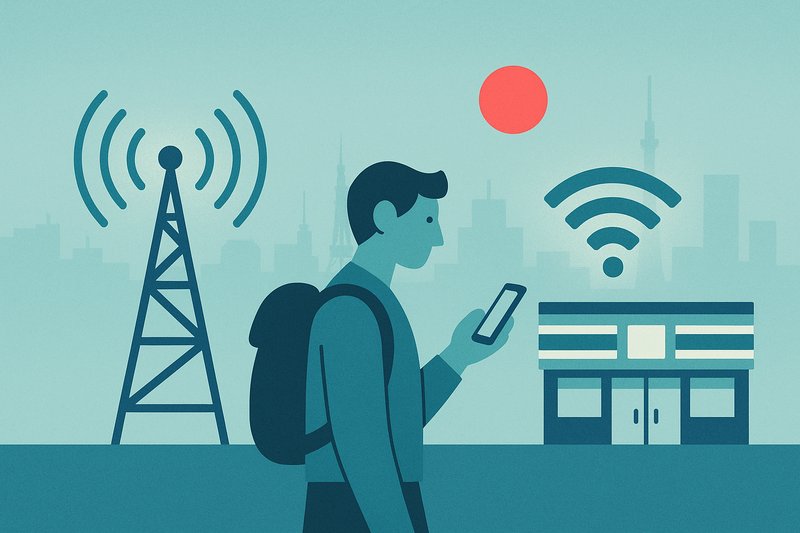
- Free Wi-Fi is everywhere — and patchy. Convenience stores, many stations, big cafes and hotels offer free Wi-Fi, so your real cellular use is often lower than you fear. But it’s inconsistent and usually needs a sign-in, so don’t rely on it for live navigation between stops. Budget for cellular; treat Wi-Fi as a bonus.
- Video is the only variable that really matters. If you won’t stream on cellular, even a “small” plan stretches a long way. If you will, jump a tier.
- Two offline tricks cut your usage to almost nothing: download Google Maps offline areas and Google Translate’s Japanese language pack before you fly. Both then work with near-zero data.
- Unlimited isn’t always worth it. Most travelers never approach the cap of a 10–20 GB plan, so “unlimited” mainly buys peace of mind for heavy streamers and long stays — not a must for everyone.
Okay, I know my number — where do I buy it?
Once you’ve landed on a GB figure, the next step is picking an eSIM with a plan that size. I keep a full, regularly-updated breakdown in my Best eSIM for Japan guide — that’s the place to start, because the “right” provider depends on whether you want budget, unlimited, or frequent-traveler flexibility.
The short version of who I point readers to, with reader discounts where we have them:
- Saily — my budget pick; clean app, sensible plan sizes. Check Saily plans (affiliate link) — 10% off with code AIFROMJAPAN10.
- Holafly — the one to look at if you’re a heavy streamer who wants truly unlimited data. See Holafly Japan (affiliate link) — 5% off with code AIFROMJAPAN.
- Ubigi — great if you travel often and want one app across countries. Browse Ubigi plans (affiliate link) — 10% off for new customers with code AIFROMJAPAN.
- Airalo — the well-known option; worth a look if you already use it. Visit Airalo. (Transparency: Airalo isn’t an affiliate partner of ours — no code or commission here. I list it because it’s a legitimate choice, not because it pays us.)
See the full Best eSIM for Japan guide →
Still deciding between an eSIM and a rental router? My eSIM vs Pocket WiFi for Japan breakdown covers that, and once you’ve bought an eSIM, how to set it up in Japan gets you online in five minutes. Not sure which brand? Here’s my Airalo vs Saily vs Holafly comparison.
Frequently asked questions
Is 1 GB per day enough for Japan?
For most people, yes. A typical day of maps, messaging, translation and casual social use runs around 500–700 MB, so 1 GB/day leaves comfortable headroom. The exception is streaming video on cellular — that can blow past 1 GB in a couple of hours.
How many GB do I need for a 7-day trip to Japan?
Around 5 GB for an average traveler. Light users can manage on 2–3 GB; heavy users who stream or share a hotspot should look at 10–15 GB.
Should I just get an unlimited plan to be safe?
Only if you’re a heavy streamer, staying a long time, or you simply don’t want to think about it. Most travelers never use the cap on a 10–20 GB plan, so unlimited is often paying for peace of mind rather than data you’ll actually use.
Does Google Maps use a lot of data in Japan?
No — navigation is one of the most efficient things you can do, around 5–10 MB per hour. You can also download offline maps before your trip to use it with almost no data at all.
Can I rely on free Wi-Fi instead of buying data?
Partly, but not entirely. Free Wi-Fi at convenience stores, stations and cafes is common and will lower your usage, but it’s inconsistent and often needs sign-in — not something you want to depend on for live navigation. Most travelers are happiest with a modest data plan plus Wi-Fi as a bonus.
What happens if I run out of data mid-trip?
With most eSIMs you can top up instantly in the app, so it’s not a disaster — but it’s an annoyance you can avoid by rounding up one tier when you buy.
About the author
I’m Ryuyan Kimura, a content blogger based in the Kansai region of Japan. I’ve been reviewing AI tools, VPNs, and password managers for English-speaking expats and Japanese learners since AI From Japan launched. I test products hands-on from real Japanese networks in Kansai (NURO Hikari fiber + ahamo / SoftBank mobile) wherever I can; long-term performance claims are backed by independent tests and real user reports.
Want the full story? Read my About page or check our Editorial Standards for how we test products.
Related Articles You Might Find Useful
If this helped you pick your number, here’s the rest of the AI From Japan eSIM toolkit: